Showing posts with label Number Talks. Show all posts

Monday, January 31, 2022

The Value of Routines

Classrooms with strong routines reap many benefits.  This has become very evident this year as i have seen so many more classrooms begin math instruction each day with a routine.

In this year of continued chaos caused by the pandemic, teachers are finding that through routines, they can reinforce and review skills from previous grades.  They are also able to use routines to preview skills that might not be coming until later in the year.  So many free, well-designed routines are out there for teachers to use that it is easier than ever to find one that meets our students' needs.

Low-floor, high-ceiling routines are wonderful for engaging all students, and they usually involve a visual that helps students to all be able to "step-in" to the learning.  Favorite examples of these types of routines include Which One Doesn't Belong and Same/Different.  Teachers and students alike enjoy these routines because there are so many possibilities within one routine as they allow students to make sense of the problems in ways that make sense to them.

Many of the routines from Steve Wyborney are also loved by teachers and students.  These routines contain visuals, offer great exposure to vocabulary, and build number sense.  Teachers love them because they are professionally made and easy to use, and students love them because they are fun!  

Of course, Number Talks also are a routine that helps to build student discourse and fluency.  Using the book as a guide for these helps students to develop and use strategies when they are ready.  Doing Number Talks regularly has been shown to grow student fluency and flexibility in computation.

As students become more familiar with routines, there are many ways teachers can tweak the format.  For example, they might decide to have students create their own following a favorite routine.  (Creating your own Which One Doesn't Belong isn't as easy it might seem.)  Students can create these routines and share them with other classrooms besides their own giving them a larger audience for their work.  Teachers might also use routines as a daily warmup such as revealing one clue a day to an Estimystery and then discussing the students' thinking at the end of the week.  I've even seen teacher print out images from routines and have students discuss them as they wait outside of a special class like PE or music.  A routine image might be part of a weekly newsletter so that families can discuss it together.   There are many ways that these routines can be used throughout a day's learning in addition to a warmup for math block.

All of these math class routines help to build a strong classroom culture of open, flexible thinking.  They also strengthen students' number sense and confidence while expanding their math vocabulary.  Teachers gain better insight to student development and can use these routines to help determine what next steps to take instructionally. They see quickly how students grow through the use of routines that meet their student needs; the routines may change from year to year.  

Math routines help us to build mathematicians whose confidence help them to take on the math practice standards as part of who they are. 


Tuesday, May 21, 2019

As another year comes to a close...


The excitement of a summer of fun is palpable at this time of the year--in both students AND teachers.  It is important that everyone have a little time away to "sharpen the saw" and give some much needed time to themselves.

However, it is also a good time to set some goals for next year.  Next year--a new beginning.  Here are some ideas for change that you might ponder this summer, and maybe you will think of some ways to make them work for you.  


Start small!  You don't need to change everything at once!  Choose one change that you want to try to start the year.  Here are my ideas and some resources to help you:


More Number talks/Math discourse:  Consider starting each day with a number talk or other math routine that encourages student discussion, reasoning, and critiquing.  Many teachers find that these help build fact fluency.  Be sure to build visuals into your routines.  Be intentional with your planning.  You shouldn't plan a year's worth of routines/number talks this summer.  The routines will vary with what your students need.  A necessary piece to this change is that you must really build a classroom culture that encourages and celebrates risk-taking, making mistakes, and curiosity.  You can find a number of resources to help you with building routines here, or you can use the word cloud on the right and click on Number Talks or Routines to read previous posts about the subject.


Heterogeneous grouping:  Many teachers group students by their perceived abilities for instruction.  Not only is this inequitable, it also leads students towards a negative perception of themselves as mathematicians.  Consider trying Visibly Random Grouping or other heterogeneous groups during your workshop.  There may still be times where you focus your reteaching with a small group on a particular skill, but in general, we want to offer the opportunity for all students to work together as much as we can.


More time for Exploration: Be less helpful.  Let students make sense of it all on their own before you begin telling them what to do.  Let them struggle with it a little, and let them use manipulatives to represent their thinking and look for patterns. When they are done with exploring, then you can work your magic by bringing it all together at the end of the class.  You'll be amazed of what they can do when they are not being told what to do.  (This may take a while unless you have already built a great culture in your classroom for risk-taking.)  These explorations could be small ones in a daily lesson, or they can be larger ones like some that are available in the word cloud by clicking on explorations.  Using Jo Boaler's WIM are also great ways to build exploration into your classroom and inspire your students.


Make tech time meaningful:  Sometimes teachers get caught up in offering tech time every day during math.  I am not a huge believer in this, as there are so many good rich problems out there for students to solve and too many rote drill and kill sites for students to work on.  Move away from these rote sites.  Instead, place students in small groups and have them work to solve meaningful problems or puzzles like those from Nrich or KenKen.  When students do go online to do work, consider trying some of the activities found on Desmos that align with your targets.  These activities require student thinking rather than just computing.


Reach out to me if you would like my support as you start to make some changes in your math instruction.  I am happy to help!

Finally, if you like to read professional books over the summer, here are some to consider:  


Friday, August 31, 2018

Continuing to Find Ways to Build Math Talk


I have participated in a number of professional discussions in the last week around the concept of Number Talks.  You may remember that I blogged about Sherry Parish's book before. It is an excellent resource to help you get started with Number Talks.

Many classrooms use Number Talks every day.  It is a great tool for building mathematical discourse, exposure to new strategies, and strengthening students' flexibility and fluency.

However--some people are a little intimidated by Number Talks.  It has some elements of the unknown, and this makes teachers a little leary to try it with their own students.  This is totally understandable.  One way to make this work is for the teacher to work on the anticipation part of the number talk fully.  By anticipating all of the possible ways a student may respond, it will give you the preparation to feel confident as you step into the Number Talk.  It will also allow you time to prepare visual images to represent ways that the students might explain.  It is important that we show the students' ideas using visual representations as this will allow us to reach more students.


I 

Here is a great example of ways that students might see 18 x 5.


I do believe that the term Number Talk is broader than just the use of functions with numbers as is found in the Number Talks book.  Of course, traditional number talks often involve quick-look cards and other visuals to help students visualize the math, but they are still considered to be from the basic concepts presented by Sherry Parrish in her book.

If you click on the tab labeled Routines located at the top of this page, you will find links to resources and videos of a large variety of mathematical routines that will encourage students' math talk.  There are many low-floor/high-ceiling activities which are good to put the students (and sometimes the teacher) at ease when doing a number talk.  In these types of tasks, nearly everyone can find an answer right away, but because these routines lend themselves to multiple answers, we find students recognizing all kinds of things besides the obvious.  Using these type of routines in addition to Number Talks will help your students to grow in ways you won't believe!

Challenge yourself to something new.  Try to add routines to your math class each day--you will be glad you did!

Friday, April 13, 2018

Prove it!

I have really been working with my Firsties groups to teach them how to "prove" their answer.  They need to prove it to themselves first through either manipulatives or a representation, and then be prepared to share their steps so that they can prove it to someone else.

Today's task was a pretty basic one, but I find that those are important for them to do as they grow their ability to explain to each other what they did and how they know.  Today I asked them to find the sum of 6 + 8.

The variety and levels of their strategies was, as always, quite interesting...


This little one counted out 6 green and 8 orange.  She needed to think about what to do with them, but she then realized she needed to put them together.  She then proceeded to count all to get to the sum of 14.

This guy counted out 6 and 8.  He organized them into a line and then counted all.  His counting was a bit easier because of the line and the differentiation between the 6 and 8, but he still counted all of the cubes to get 14.

A similar approach with the counters...this little guy organized his 6 yellow and his 8 red.  He began with the 6 at the top and then counted on the next 8 to get 14.

Here was one who grouped his 8 and 6. He then started with the 8 and counted on the next 6 to get 14.  He decided to build the plus sign while he was waiting for the others.


There was some organization in this guy's work.  He grouped his 8 and 6 and then counted on from 8 to get his 14.  While he was proving it to the group, one of the others,  who had used a much more mottled strategy, blurted out, "It's a ten frame!" We took the time to explore how it was like a ten frame, but not quite, so we moved two yellow to the end of the black blocks to make our ten.  They immediately saw the 10 +4 and called out, "14!"


Now it was my turn.  I started with a stack of 6 and a stack of 8.  This time, however, we broke two off of the 8 to identify that each of the stacks was now worth 6, and the students called out, "6 + 6 =12." They then knew they needed to add the two back to get the 14.

This little activity doesn't take us long, but it shows me so much about the students' thinking and levels.  They have all been taught in the classroom to "start big and add on."  However, when working independently, they don't all do that.  When we look at each other's strategies, we identify how it works for each person.  We identify what looks the same and what looks different.  I model and discuss the way to organize our blocks so that they are easier to total.  In the end, however, we have a discussion about the fact that there are many ways to get to the same place.  We all need to use what makes sense to us.  

I was glad to see when I was in one of these student's classrooms today leading a 3 act task that one of the students that I see regularly was organized in her representation of the problem.   We were able to share her representation with the class and discuss how the organization that she used helped to make finding the sum a little easier.  

They are 6 and working to make sense of it all.  😃


Tuesday, December 19, 2017

Math Talk: Another way to encourage it!

I am always looking for new ways to engage students in math talk.  Math talk is such a powerful tool for building student understanding!

A website I recently found offers some great discussion starters that could be used in a variety of ways in your classroom.  Same but Different Math offers your students images to compare and contrast. These images are categorized to improve your search for what you need.

Let me know what you think about this site or if you would like my help in implementing its images in your classroom!


Wednesday, November 1, 2017

More Real World Math Errors


Kids love to find mistakes that others have made.  The attached file is full of errors found in the real world.  Can your students figure out what is wrong?  

Some of these are geared for older students, but there are some in here for the littles, too!

You can use these as a number talk, an opening activity, a collaborative problem solving activity...just be sure to get the best thinking, can they figure out how to correct it?

If your students like these, here are some from an earlier post.

Click for new file


Monday, October 30, 2017

Building Fraction Understanding


In a recent webinar by Graham Fletcher, he discussed the enigma of fractions for a student.  He had what I believed to be a great perception. Just like we teach kids to subitize whole numbers, we could dispel the notion that fractions are difficult by having kids learn to subitize fractions.   And, just as we have students subitize whole numbers in many different ways--through dominoes, fingers, dice, tally marks...we should present fractions in many different ways in order for them to be able to better understand their meaning.

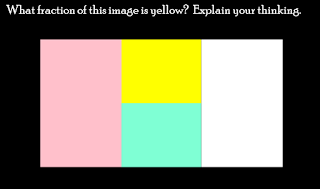
The SMART document that I made stems from Graham's idea, but I also made it with Number Talks in mind.  I think these images could bring up some good math discussions and justifications of fractions.  It is made with images that are easy enough for 1st grade, and some that would be relevant in a 5th grade class.

If you decide not to use the image as a number talk, you might print out a page of the SMART document and have it be a collaborative activity for kids to decide.  

No matter how you use the pages in this doc, it would probably be good to print out the image so that students could cut the pieces apart so that they could prove their thinking to themselves and others by manipulating the pieces of the image.

Sample image from Fractions SMART doc. Click to download document.
Do you have other ideas on how you could use the pages in this document?  Feel free to share below.

Sunday, September 10, 2017

Websites to help you kick your teaching up a notch!


I have recently come upon these math websites...

I think they can be used in a variety of ways in our classrooms. There are prepared resources on these sites, but they might also inspire you to create your own.  It might also be a good opportunity for students to create them.

Would You Rather?  This site gives two mathematical questions and students have to determine which they believe will give them the better result.

Estimation 180  This site offers opportunities for students to estimate with the hope that practicing estimation more often will build their number sense.

Fraction Talks Images from this site support the teaching of fractions.  Ideas for using these images are limitless, but as a number talk might be a great way to start.

Visual Patterns  The images on this site are the beginning of a pattern.  Can your students figure out how the pattern works?  Can they write an equation to match it?


All of these sites offer opportunities to expand their thinking and especially their thinking about math.  Many of them are low floor/high ceiling tasks meaning that all of your students can be successful with them.  Consider using them with all students!

I would be happy to help you find ways that these activities could work for you and your students.  Just let me know how I can help!


Monday, June 5, 2017

Building Mathematicians through Number Talks

I have had a number of teachers show interest in adding Number Talks into their classrooms next year.  That is awesome!

Many of you already use Number Talks regularly.  For those of you who don't, I think you will find that you already do forms of this.  The difference between about what you are doing now and a number talk is generally just one thing--intentionality of instruction.

In this video, you will see a 3rd grade Number Talk.  I think you will be able to recognize the intentionality he uses in this lesson.

https://www.teachingchannel.org/video/multiplication-division-in-the-core
There are many things that I like about this video. I like the classroom culture and the way that everyone is engaged in the activity. I think it is wonderful the number of ideas that they share and the way that the teacher acknowledges each one. I love the way the hand signals give the teacher feedback, but don't distract everyone else's thinking.  However, my favorite part, I believe, is when the student says, "I revised my thinking..." How powerful is that?

 There are lots of ways that you can use Number Talks in your classroom. You might use it as a mini-lesson. It might be an opening or closing activity. It might be designated for a certain time of day outside of math time. You might use it once a week, or you might use it every day. All of that is up to you and what works best for you and your students.
Sherry Parrish's book is a great resource. Many teachers and buildings have copies of this great book. This link also will also give you some ideas of different Number Talks you can use in your classroom. 

 As always, I would love to explore this more with you. If your class uses Number Talks regularly, let me know! I would love to visit if you are comfortable with that. If you would like to learn more, or sharpen your skills at these, I'd be happy to chat with you.