Showing posts with label games. Show all posts

Friday, August 11, 2023

A new puzzle to consider

Recently, a friend introduced me to this game/puzzle, and I wanted to be sure to share it with you.  It might be a great thing to use your PTO money or ask a generous parent to pick up for the class.

The only problem I really have with this game is its name: Genius Star.  I hate for that to cause students to believe they aren't capable of solving it, or vice-versa, that if they are able to solve it, it makes them a genius! 

This puzzle explores spatial relationships which for so many of our students can be a challenge.  It also offers students the opportunity to distinguish pieces they should prioritize as well as a trial in perseverance!

Here's how it works:

Roll the die that come with the game:


Lay the little white triangles onto the corresponding triangles on the board:

Now, I usually solve these on my own, and I don't recommend that it becomes a racing game, but students then take the 11 game pieces and place them on the board to cover in the star.


Students can compare their solutions to see what they did the same or different.


Students can also reflect on what made the puzzle challenging or easy. 

The box comes with two black trays to solve the puzzle on, but you could maybe get more than one game so that more students could work to solve. I find it quite fun, and it highlights the spatial skills of math.  The company makes other similar games that will show up when you follow the above link to this game.

Students can solve the puzzle in pairs and discuss their findings, they can investigate the dice and the regions of the board that each one covers, they could create their own puzzle numbers that they think are unsolvable and ask classmates to prove them wrong, they could create fractional questions about the puzzle or its pieces, or you could use two solutions for the same numbers as a same/different discussion. It seems to me like there are a lot of ways that this little puzzle could be used!

Let me know in the comments if you have found or find other ways to use this puzzle in the classroom!

Tuesday, November 29, 2022

Mathigon & Polypad & Puzzles...Oh My!

I have been a fan of Mathigon's Polypad for quite a while now, and have found many great ways for it to be used to help students build better mathematical understanding as well as to challenge their current understandings.

I want to share a few of the great resources available on Mathigon in hopes that you will find ways for them to work for you and your students!

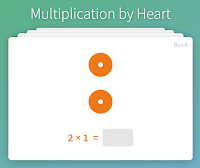
The Multiplication by Heart cards (created by Math for Love) are great visual practice for students as they learn to understand and master their multiplication facts.  


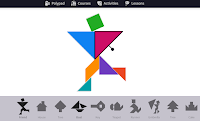
Of course, I also enjoy the Tangram  Builder which is located in the Activities section.


Exploding Dots can also be found here.  If you have not spent time in the Exploding Dots world by James Tanton, do yourself and your students a favor!  It would make for a great exploration for your students.  The Exploding Dots experience on Mathigon is an extension of the actual website, but still one to get you thinking.


What really got my attention on Mathigon is its Polypad section!  It has so many unique manipulatives and tools to offer your students.

This polypad includes a balance scale and fraction bars. Each could be used separately.


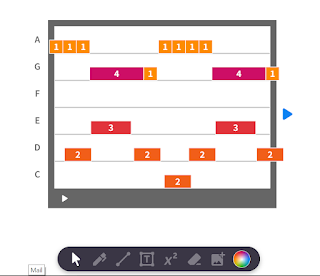
Students can make music using these tools found in Polypad.


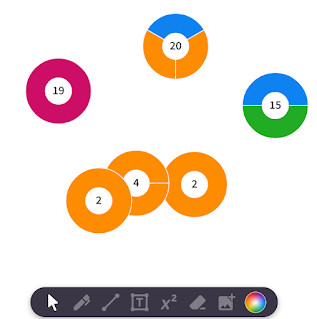
These Prime Factor Circles are a match to Prime Climb and can be decomposed (if composite) or combined as you wish to create new products.


This is just the tip of the iceberg in this fabulous site.  You can save and link activities that you make within the Polypad, but you can also use some of the many that are already prepared.  One last thing to explore is the Lessons tab.  Inside of there you will find your way to a variety of puzzles and explorations for you and your students.

Take the time for your students and yourself to explore this site.  You won't be disappointed!


Thursday, November 29, 2018

Countdown to the Holidays!

You know how I love nrich.maths.org for rich problems to solve.  Well--today I saw that they have an advent calendar for elementary students.  Each day has a rich task that accompanies it.  The problems are not holiday based; only the design of the calendar is.

You might just refer to it as a holiday countdown calendar, but no matter what you call it, it should lead to some good student thinking!


Wednesday, November 15, 2017

Holiday Goodies

Every year the holidays seem to approach more quickly....it must be a sign of my age.  😏


I know how hectic the classroom can be as you prepare for the holidays...you are trying to finish up units, students are distracted, special events and assemblies get in the way, students leave for break a day or two early....

With that in mind, I prepared something for each grade level that I think can be used as independent work, partner work, or in another way that works best for you.  The 3rd, 4th, and 5th grade activities involve story problems which mostly align with the spring PARCC testing.  You should find that some of the pages are things that your students have already studied this year.  Of course, you might decide to look through one of the other grade level's sets of problems--as some of those pages might better fit the needs of your students.


If you are looking for other activities that might be good for your classroom during December, you might check out these previous posts:


Sunday, November 13, 2016

Games That Cover Key Concepts

Calculation Nation is part of the NCTM's Illuminations site.  The games on Calculation Nation allow students to compete virtually with other students around the world to practice key concepts of the upper grades: fractions, geometry, and factors and multiples to name a few.

Here are some ways I think these games could be used in the classroom.

1) Set up accounts for all of your students to play as they wish.

2) Set up a class account and then play on the SMARTBoard as a class to practice key concepts.  

3) Have students sign in as a guest to play the concept that practices an important key concept.

Playing these games on the SMARTBoard to start or finish a lesson could lead to some great number talks and problem solving discussions.  

Share your ideas with others.  Have you tried these games before?  Which ones work?  Which need special preparation?

Share this post with a friend.

Thursday, October 27, 2016

Have you checked out Greg Tang's website?

You might know Greg Tang from his great math books like The Best of Times,  The Grapes of Math, or Math Potatoes.   Many of his books are included in our Math Reads sets that we received last year.  His books are great mentor texts for reading, writing, or math workshop!  He includes strategies to help the reader make sense of the numbers.

Whether you are familiar with his books or not, his website is a great resource for all grades!
On this site, he has activities that correlate with his books. (One of these could make a great minilesson.) He has a word problem generator which allows you to differentiate your problems depending on student needs.  In addition to those great features, the site also has some pretty awesome games.  These games are leveled and many can be used from K-5.  The games allow for practice on subitizing, coins, integers on a number line, and more.

I think this site deserves a look-see.  Let me know what you think!


Sunday, September 18, 2016

Make Ten Resources


Making ten is  an important addition strategy for primary grades.  Here are some resources to help your students comprehend the concept as well as develop some automaticity of facts.  When working on facts, always try to have your students first involved concretely, then pictorially, then numerically/abstractly.  Fact fluency involves good understanding of the concept--not just rote memory. I have labeled each activity with a C, P,or an A.  

Most of these would make great math stations! (Many of the examples have links to PDFs, SMART Notebooks or other things you might need)

This picture shows a life-size idea for ten frames.  You might also consider having your students stand in the spaces of the ten frame for a more kinesthetic experience.  Dr. Nicki recommends using a shower curtain and duct tape.  I have found that plastic tablecloths hold up pretty well to kiddos standing/walking on them, too.   C


Number Bowling:  This game comes from What the Teacher Wants.  Students bowl the tennis ball and then figure out the combination that made 10.  I think you could play it with an addition or subtraction number sheet. Here is a recording sheet to help with subitizing and recording their game. C


Make Ten Bracelets:  This idea comes from Kindergarten Doodles.  You could use pipe cleaners as bracelets or beaded number lines of ten... C


Ten Frames Puzzles:  These ten frame puzzles are from FirstGradeTeacherLady.  P


Visualizing/Modeling Template:  This template has kids show the fact in a variety of ways.  Maybe you make a book of them for Make Ten facts...P


Make Ten games:  This doc contains three different "games" for making ten.  Each game requires a 10 sided die.  They can be played as an individual or with a partner.  A (but could be Concrete if you provided manipulatives)

Number Bonds Game: I have shared the number bonds link before, but this one focuses on making ten.  A great online challenge.  A

This video uses pictures, numbers, and music to teach.  P  

SMARTBoard Games: This doc has two different pages that you could use as a whole class to practice Make Ten Facts.  A

Once you think that a fact strategy has been conceptualized, try it out with story problems. This page is a start to some Make Ten story problems for your children to solve.  Consider including manipulatives and encourage drawings or number lines to show their thinking! P/A

In the end, our goal is to help kids see the relationship between a number and ten.  If you are interested in using subitizing in your classroom in a more systematic way, consider registering for these 3 free videos for some great professional development.  You can do them at a time that works for you. They are presented by Christina Tondevold, the Recovering Traditionalist.

If you have a colleague you think would like this post, please share. Do you have other ways you work to teach Make Ten facts?  Share in the comments.  :)

Thursday, September 1, 2016

Some Fun Online games

Looking for some different online games to try with your class?  Games are a great way to get students excited while practicing math concepts.  Practice sites like IXL, Xtra Math, and Front Row are okay for drill practice, but sometimes you might want to mix it up.  Kids love Sumdog which practices many skills using many games, but sometimes I know you are looking for games that pinpoint specific skills.

Here is a list of just a few.  You might use them as a station, play them as a class, or share with parents as a way to practice skills at home.


Many of the games come from sites that have a multitude of great games available.  I am only spotlighting a few.


Curious George Hide and Seek: This game follows George through other settings.  Students are asked to identify digits, number words, and sets of objects.  Appropriate for K.

Sum Links:  Students match addition and subtraction statements to make target numbers. This site becomes more difficult as students progress through the levels.  This game is appropriate for Grades  1-2.


Number Bonds:  Players shoot little pinballs as moving targets to make a total of 20.  Requires quick eyes and good aim!  Fun.  Appropriate for Grades 1-2.


Bang on Time:  This clock game has adjustable speeds.  Students try to stop the clock at the time written on the screen.  This game provides good practice of time language.  It works great on the SMART Board.  Appropriate for Grades 2-3, but 4-5 might like for review.


2D Shape Jeopardy:  Little Jeopardy game that reviews the basics.  Appropriate for Grades 2-3.


Multiplication Blocks: This is a race game. Students try to find factors of the target number falling down the side of the screen.  The goal is to hit the factors before the number hits the bottom. Levels become progressively harder.  Appropriate for Grades 3-4.  Good review for 5.


Speedway Fractions:  Another race game. Student answer addition and subtraction problems of fractions with like denominators.  Answers are sometimes in simplest form.  Student moves across the track faster when he answers quickly and correctly.  Appropriate for Grade 4.


Weigh the Wangdoodles:  What a great challenge game!  This game uses pre-algebra and logical reasoning to have students determine the weight of each of the little wangdoodle monsters.  Cute!  Appropriate for Higher students in Grades 3 and 4 and Grade 5.


Let me know if you are looking for a game for a specific skill or grade level.  I will be happy to help you find one that fits your needs!