Showing posts with label puzzles. Show all posts

Friday, August 11, 2023

A new puzzle to consider

Recently, a friend introduced me to this game/puzzle, and I wanted to be sure to share it with you.  It might be a great thing to use your PTO money or ask a generous parent to pick up for the class.

The only problem I really have with this game is its name: Genius Star.  I hate for that to cause students to believe they aren't capable of solving it, or vice-versa, that if they are able to solve it, it makes them a genius! 

This puzzle explores spatial relationships which for so many of our students can be a challenge.  It also offers students the opportunity to distinguish pieces they should prioritize as well as a trial in perseverance!

Here's how it works:

Roll the die that come with the game:


Lay the little white triangles onto the corresponding triangles on the board:

Now, I usually solve these on my own, and I don't recommend that it becomes a racing game, but students then take the 11 game pieces and place them on the board to cover in the star.


Students can compare their solutions to see what they did the same or different.


Students can also reflect on what made the puzzle challenging or easy. 

The box comes with two black trays to solve the puzzle on, but you could maybe get more than one game so that more students could work to solve. I find it quite fun, and it highlights the spatial skills of math.  The company makes other similar games that will show up when you follow the above link to this game.

Students can solve the puzzle in pairs and discuss their findings, they can investigate the dice and the regions of the board that each one covers, they could create their own puzzle numbers that they think are unsolvable and ask classmates to prove them wrong, they could create fractional questions about the puzzle or its pieces, or you could use two solutions for the same numbers as a same/different discussion. It seems to me like there are a lot of ways that this little puzzle could be used!

Let me know in the comments if you have found or find other ways to use this puzzle in the classroom!

Tuesday, November 29, 2022

Mathigon & Polypad & Puzzles...Oh My!

I have been a fan of Mathigon's Polypad for quite a while now, and have found many great ways for it to be used to help students build better mathematical understanding as well as to challenge their current understandings.

I want to share a few of the great resources available on Mathigon in hopes that you will find ways for them to work for you and your students!

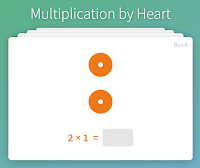
The Multiplication by Heart cards (created by Math for Love) are great visual practice for students as they learn to understand and master their multiplication facts.  


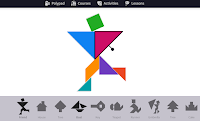
Of course, I also enjoy the Tangram  Builder which is located in the Activities section.


Exploding Dots can also be found here.  If you have not spent time in the Exploding Dots world by James Tanton, do yourself and your students a favor!  It would make for a great exploration for your students.  The Exploding Dots experience on Mathigon is an extension of the actual website, but still one to get you thinking.


What really got my attention on Mathigon is its Polypad section!  It has so many unique manipulatives and tools to offer your students.

This polypad includes a balance scale and fraction bars. Each could be used separately.


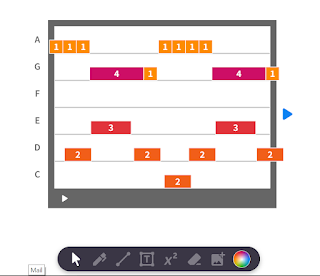
Students can make music using these tools found in Polypad.


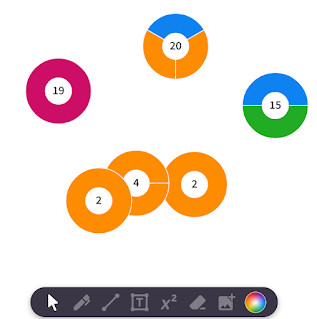
These Prime Factor Circles are a match to Prime Climb and can be decomposed (if composite) or combined as you wish to create new products.


This is just the tip of the iceberg in this fabulous site.  You can save and link activities that you make within the Polypad, but you can also use some of the many that are already prepared.  One last thing to explore is the Lessons tab.  Inside of there you will find your way to a variety of puzzles and explorations for you and your students.

Take the time for your students and yourself to explore this site.  You won't be disappointed!


Friday, October 18, 2019

Playing with Numbers

After reading the book Math Recess by Sunil Singh and Dr. Christopher Brownell, I realized the importance of giving students time to explore numbers by playing with them.  This post shares a couple of ideas for these explorations.


This book is a great read and will make you rethink your instructional practices!
Abundant Numbers:  Have students search for ABUNDANT NUMBERS.  A number is considered abundant if the sum of its divisors is greater than the number.  For example, twelve is abundant because its divisors (1,2,3,4, and 6) is greater than 12.How many can your students find?

Circular Primes:  A circular prime is one that remains prime with the relocation of the first digit to the end.    So for example, 113 is a circular prime:  113 is prime.  When I move the 1 to the end of the number, my new number is 131, which is also prime.  When I again  move the first digit to the end, I get the number 311.  It is also prime; so it means that all 3 of those numbers are CIRCULAR PRIMES.

Happy Numbers: 19 is a HAPPY NUMBER.  How do I know?  To find a happy number, square each digit and find the sum. Continue doing until you find the final number.  If it is 1, then the number is happy.  
Click here to see how I know 19 is happy!

Make it a goal to give your students some time with these ideas.  Can they find more of any type of number?  How many can your class find this week?  before winter break?  this school year?  Can they prove that the numbers they found fit the definition provided?


Let your students spend time playing and thinking about numbers.  

Tuesday, May 21, 2019

As another year comes to a close...


The excitement of a summer of fun is palpable at this time of the year--in both students AND teachers.  It is important that everyone have a little time away to "sharpen the saw" and give some much needed time to themselves.

However, it is also a good time to set some goals for next year.  Next year--a new beginning.  Here are some ideas for change that you might ponder this summer, and maybe you will think of some ways to make them work for you.  


Start small!  You don't need to change everything at once!  Choose one change that you want to try to start the year.  Here are my ideas and some resources to help you:


More Number talks/Math discourse:  Consider starting each day with a number talk or other math routine that encourages student discussion, reasoning, and critiquing.  Many teachers find that these help build fact fluency.  Be sure to build visuals into your routines.  Be intentional with your planning.  You shouldn't plan a year's worth of routines/number talks this summer.  The routines will vary with what your students need.  A necessary piece to this change is that you must really build a classroom culture that encourages and celebrates risk-taking, making mistakes, and curiosity.  You can find a number of resources to help you with building routines here, or you can use the word cloud on the right and click on Number Talks or Routines to read previous posts about the subject.


Heterogeneous grouping:  Many teachers group students by their perceived abilities for instruction.  Not only is this inequitable, it also leads students towards a negative perception of themselves as mathematicians.  Consider trying Visibly Random Grouping or other heterogeneous groups during your workshop.  There may still be times where you focus your reteaching with a small group on a particular skill, but in general, we want to offer the opportunity for all students to work together as much as we can.


More time for Exploration: Be less helpful.  Let students make sense of it all on their own before you begin telling them what to do.  Let them struggle with it a little, and let them use manipulatives to represent their thinking and look for patterns. When they are done with exploring, then you can work your magic by bringing it all together at the end of the class.  You'll be amazed of what they can do when they are not being told what to do.  (This may take a while unless you have already built a great culture in your classroom for risk-taking.)  These explorations could be small ones in a daily lesson, or they can be larger ones like some that are available in the word cloud by clicking on explorations.  Using Jo Boaler's WIM are also great ways to build exploration into your classroom and inspire your students.


Make tech time meaningful:  Sometimes teachers get caught up in offering tech time every day during math.  I am not a huge believer in this, as there are so many good rich problems out there for students to solve and too many rote drill and kill sites for students to work on.  Move away from these rote sites.  Instead, place students in small groups and have them work to solve meaningful problems or puzzles like those from Nrich or KenKen.  When students do go online to do work, consider trying some of the activities found on Desmos that align with your targets.  These activities require student thinking rather than just computing.


Reach out to me if you would like my support as you start to make some changes in your math instruction.  I am happy to help!

Finally, if you like to read professional books over the summer, here are some to consider:  


Monday, March 4, 2019

Using Puzzles to Create Persevering Problem Solvers


Helping our students to grow through productive struggle is often a challenge for us.  One way to consider as you work to build your students' problem solving skills is through the use of puzzles.  Here are some ideas for you to consider:

Yes--it can be as simple as having a jigsaw puzzle in the back of your classroom.  The visual acuity needed to solve jigsaw puzzles is important for students to build, and who doesn't love to finish a jigsaw puzzle?  Oftentimes, students do not have this opportunity at home, so having one set up in your classroom could help them to develop a new skill or hobby.

Besides jigsaw puzzles, tangram puzzles and pattern block puzzles also help students to build visual and geometric skills.  Allowing students time to explore with tangrams and pattern blocks is important, too, and it allows them to find the creativity in math as well as in themselves.  You can find other resources to help with tangrams in this post as well.

Kenken puzzles are an awesome tool to help build logic, fact fluency and number sense in all students.  The website also has an education portion, and you can sign up to have new sets of these puzzles sent to you weekly.  These puzzles are one of my favorites, but you do need to take a little time being sure your students understand how to do them and reminding them to explain how they know where numbers go in the puzzle.  Too often, students will guess where numbers go.  This method will work for a short time, but as the puzzles become more difficult, guessing will not lead to success.   While Kenkens have some similarities to Sudoku, I think they are better in the classroom because of the decomposition of numbers that is involved.  Many students are familiar with Sudokus, and they are a great type of logic puzzle that can be easily found. More information about Kenkens can be found here.

The website Math Pickle also has a large puzzle bank for you to choose from.  This site offers students the opportunity to play with their work in a way that allows them to better develop math concepts.

These puzzles from the Julia Robinson Mathematics Festival also allow students an opportunity to persevere through problem solving in  a fun way.  Although developed for a building-wide math night, many of the puzzles could be used in the classroom.

Let students decide how they want to do their puzzles.  Sometimes students prefer to solve them alone.  Others need to talk it over and think it through with a classmate.  Neither way is wrong.  Let students build their puzzle-solving skills in the way that feels best to them!

Math is fun.  It is puzzles.  It is visual. It is cooperative.  Sometimes, we get so caught up in teaching a curriculum or a standard, that we forget these important pieces of math.  There are so many good puzzles and problems out there for students; this is not even the tip off of the iceberg.  In what ways can you work to incorporate some of these ideas/resources into your classroom.  How can you help your students to not only become more persevering, but to ENJOY doing math?  

Thursday, November 29, 2018

Countdown to the Holidays!

You know how I love nrich.maths.org for rich problems to solve.  Well--today I saw that they have an advent calendar for elementary students.  Each day has a rich task that accompanies it.  The problems are not holiday based; only the design of the calendar is.

You might just refer to it as a holiday countdown calendar, but no matter what you call it, it should lead to some good student thinking!


Wednesday, April 25, 2018

Another puzzle website!

I have posted before about the algebraic thinking mobile puzzles from Solve Me Puzzles.  They are great for increasing our students' understanding of equality, and they give even our youngest students some exposure to algebra concepts.

Solve Me Puzzles has another great puzzle called Who Am I?  These place value puzzles ask students to figure out the value of the number from the clues.  There is some similarity between these puzzles and our Everyday Math place value puzzles.
On both sites, the puzzles progress in difficulty.  I think both puzzle sites could be used in some way with students in 1-5.

There is a third puzzle available on the Solve Me Puzzles menu.  It is called Mystery Grid.  You might have students who enjoy it, too.  It has some similarities to Sudoku puzzles and KenKen puzzles.  (I don't find it quite as much fun as KenKens...)

These puzzles might work well as an opening or closing activity during your day, a partner activity, or a station during math workshop.  They will definitely help build our students reasoning, thinking, and mathematical skills!

Thursday, February 8, 2018

Algebraic Thinking Puzzles


I am often asked about ways to challenge our students during math workshop.  I believe it is important that we have a variety of problems that we use.  I also don't think we should spend much of our time accelerating content to teach our students things beyond our grade level.  There are many ways we can build their thinking and logic skills by having them look at numbers more flexibly. Building deeper thinking skills will enable them to persevere as they move into more challenging problems in the future. 

I recently came upon this site.  I think it could have many uses in classrooms as low at 1st grade.  Teachers could use some of the puzzles for a whole class think aloud.  They might also choose to have students work in partners to solve the puzzles.  They might print out a few of the puzzles and have students work on them on paper.  They might introduce some individual students to them.

These puzzles offer students opportunities to think algebraically about numbers and to better explore the meaning of equality and balance.  

Solveme puzzles has three levels of problems:  Explorer, Puzzler, and Master.  Problems become progressively more difficult as students move through the levels.  There are some that involve fractions and negative numbers.   I solved all of my problems as a guest, but you might find it beneficial to create accounts for students.

Let me know what you think of this site.  Feel free to share it with a colleague.  Try some of the puzzles yourself--you might find that you enjoy them, too!

Monday, December 4, 2017

Math Maven's Mysteries

It always amazes me the free things that I find out there on the internet...

Link to Scholastic's Math Maven's index page


This site from Scholastic offers interactive math mysteries of all levels and on a variety of math topics.  They would be great to use as a small group activity or a problem-solving station during workshop.  It offers many great resources.  Many of the problems are ready for the SMARTBoard, there is the opportunity for the story problem to be read to the students, the teacher's resource has many supplemental activities, and you can print out paper copies for students as well!  The main page provides links to all of these options.  I hope you can find something that will fit your classroom!


Wednesday, October 25, 2017

Toying with Tangrams


Do you enjoy the challenge of a good puzzle?  Sometimes, people really like them, and sometimes--not so much.  However, most people believe that puzzles are a necessary component to child development.  They help children to build spatial relationships as well as problem-solving skills.  Besides that, the hands-on component of puzzles is an important form of learning for some of our students.

Tangrams are the puzzles that especially seem to connect with math because of their geometric shapes.  If you want to introduce  your students to tangrams, this book is a great start!
You might decide to read and discuss this book as part of reading workshop, or it might be part of your listen to reading activities when you send students to this Youtube video of the book.  No matter how you decide to use this book, it is one that students are sure to enjoy!

Another great book to use with younger kiddos is this one:


If your students are older, you might be able to review the legend of the tangram, and then have them move into building with tangrams.  You might have them as a recess activity, an activity that they can choose when they have completed their work, or a math station.

Here are some resources that might help you put tangrams in your students' hands:


A friend of mine used to make each of her students a tangram set for the holidays each year.  She would then print out a couple of patterns that they could do at home, too. What a great idea!

Once your students become used to tangrams, you might try a literacy activity I used to use as an option for my kiddos:

After reading a book, they would make a tangram picture that represented the beginning of the book and then write a sentence or two about the beginning.  They would do the same for the middle and the end.  It was a fun option for some of the kids!

Do you have other ideas for Tangrams?  I'd love to hear them. Please comment below if you do.


Thursday, October 19, 2017

Looking for Extension Activities for Unit 4?


If you have some students who pretest out of Unit 4 in Everyday Math, you may find some of these activities will help meet their needs.  Even if you don't have students who test out of the unit, these activities will take some of your grade level's unit skills and look at them at a higher level.

1st grade:
Game of Totals --whole day lesson from Youcubed
Snap It--great small group activity that could be used for combinations of 10
Eggs in Baskets--problem solving problem with conditions that make kids make sense
The Brown Family--problem solving activity
Make Ten blog post--this blog post from last year focuses on resources to help teach making ten
Popping Balloons--A 3-Act task that focuses on combos to 10

2nd grade:
How many Times?--problem solving activity about time
Wonky Watches--another problem solving activity about timeWhich is faster?--problem solving about place value and giving supporting evidence for your thinking
That number square--problem solving about numbers to 100
Fruit Shoot--online place value game where students match base ten blocks to numbers. FUN!
Place Values Shapes game--another fun online game for kiddos to think about place value differently.  Challenging!
Place Value Pirates--online place value game
Would you rather--scenario where students choose what they think is the better choice

3rd grade:
Area Shapes game--good review interactive game for students to practice area
Perimeter Shapes game--online review game that practices perimeter
Quadrilateral Shapes game-- interactive game that has student practice with different types of quadrilaterals
Rectangle Interactive--this interactive activity helps kids connect area to the length of the sides of the rectangle
Paper Cut--3 Act Task that explores area
Numerically Equal--problem solving that asks students to look at area and perimeter
Quadrilaterals--problem solving that looks at different attributes of quadrilaterals

4th grade:
All the Digits--problem solving involving multiplication
Shape Times Shape--multiplication problem solving with an introduction to algebra
Table Patterns Gone Wild!--looking for patterns in multiplication tables
Multiplying two-digit numbers--Open Middle activity for finding a product
Massive Mosaic--3 Act Task which focuses on multiplication of two 2-digit numbers
Would you Rather--scenario where students have to choose and defend the better choice

5th grade:
Scooter Quest--online game to practice decimal place value
Rounding Decimals--Open Middle rounding decimals problem
Meteor Coordinates--This onlinegame gives students a chance to explore coordinate pairs.
Place Value Pirates--online game to practice decimal place value
Hungry Puppies--online game where students choose decimal values to combine to make the target
Matching--this online game has students match decimals, fractions, and percentages
Round the dice--an investigation about rounding decimals
Spiralling Decimals--a game of strategy and knowledge of decimal size

If you have other resources to share, please add them in the comments below!


Wednesday, October 11, 2017

Halloween and Logic


Construct viable arguments and critique the reasoning of others.


This mathematical practice standard is one that needs to be practiced often with our students.  However, some of them get so flustered by the math that they can't explain their reasoning to others let alone listen to other students' ideas.

Consider trying these logic puzzles with your students.  Logic is a great way for students to practice their thinking, and it is often easier for some of our kiddos who struggle with some of our grade level content.

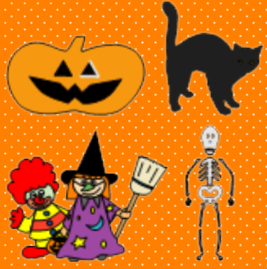
These logic puzzles are October/Halloween themed and vary in difficulty. They are good practice at thinking skills but also in relational words.  I have also created a document for you that has the images for the puzzles.  Often, it helps the students to have something to move around on their desk.  You can just give them a strip of pictures that matches the puzzle you are doing, they can cut the images apart, and then move them as necessary to solve the problem.

If your students like these, consider an activity where groups try to make up their own.  It is more challenging than it looks.

Please share with a colleague.  Comment below if you find other ways to use them in your classroom.


Monday, June 26, 2017

Primary Counting Puzzles

Recognizing patterns helps students to become better thinkers and problem solvers.  Counting and Cardinality are a big focus in kindergarten.  With this in mind, and taking an idea I saw somewhere, I created these puzzles for primary students.  I think they would be good in a station or as something for the kids to do when they finish other work.  Maybe you would want to use one for classroom management?--the class earns a piece when it reaches a goal, and when the puzzle is complete, they earn a reward.  I am sure you can think of some great ways to use them.  You'll just need to download the file, print it in color, laminate if you wish, and cut! Click on the image below for the entire set of 7 puzzles.