Showing posts with label explorations. Show all posts

Tuesday, March 7, 2023

March is Full of Palindromes this Year!

 As we approach the end of March, we come close to multiple school days which are palindromes. From 3-20-23 to 3-29-23, our dates will be palindromes, and they may offer opportunities for you and your students to explore palindromes!

Students of all ages can look more closely at palindromes! I am going to focus on explorations with numbers, but your students might enjoy finding words that are palindromes, too. Here are a few books you might share with your students:


Some of your students may get caught up in noticing individual words that are palindromes, but some may enjoy the word play involved in sayings and phrases that are palindromes.  At either level, it is word work that many students find FUN!

For math explorations, you might not explain to your young students what a palindrome is, but let them discover!  

  • Using your pattern blocks as a visual, you can give students numbers to "create" and allow them to notice what makes these numbers special.  For example:


If you display the pattern blocks to represent different digits, then you can dictate numbers and ask students to create them.  Can they identify the pattern that makes palindromes special?  Can they see with the March dates how they are palindromes?

  • Ask your students to find all of the palindromes between 0 and 100.  What do they notice about two-digit palindromes? Is there a pattern in 3 digit palindromes?
  • Will there be other palindromes this year?  How about next year--What palindromes will there be?  Is there ever a year without a palindrome date?  What can your students find?
  • Finding palindromic numbers Math For Love has a great lesson exploration opportunity where students search for different levels of palindromes. It offers a way for students to add, look for patterns, and have fun with numbers--all in one activity!

I hope you and your students find some time to explore the fascinating patterns and elements of palindromes in our words and numbers!  You might want to consider ending with this Weird Al video, Bob, which is made entirely of palindromes.

Tuesday, November 29, 2022

Mathigon & Polypad & Puzzles...Oh My!

I have been a fan of Mathigon's Polypad for quite a while now, and have found many great ways for it to be used to help students build better mathematical understanding as well as to challenge their current understandings.

I want to share a few of the great resources available on Mathigon in hopes that you will find ways for them to work for you and your students!

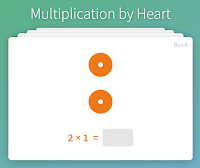
The Multiplication by Heart cards (created by Math for Love) are great visual practice for students as they learn to understand and master their multiplication facts.  


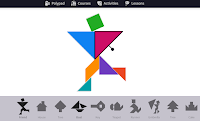
Of course, I also enjoy the Tangram  Builder which is located in the Activities section.


Exploding Dots can also be found here.  If you have not spent time in the Exploding Dots world by James Tanton, do yourself and your students a favor!  It would make for a great exploration for your students.  The Exploding Dots experience on Mathigon is an extension of the actual website, but still one to get you thinking.


What really got my attention on Mathigon is its Polypad section!  It has so many unique manipulatives and tools to offer your students.

This polypad includes a balance scale and fraction bars. Each could be used separately.


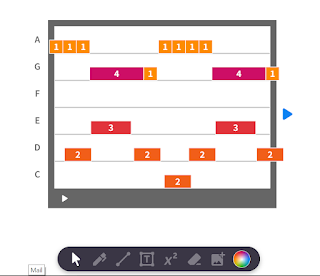
Students can make music using these tools found in Polypad.


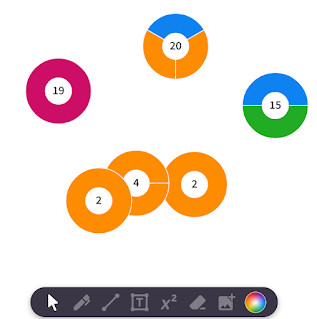
These Prime Factor Circles are a match to Prime Climb and can be decomposed (if composite) or combined as you wish to create new products.


This is just the tip of the iceberg in this fabulous site.  You can save and link activities that you make within the Polypad, but you can also use some of the many that are already prepared.  One last thing to explore is the Lessons tab.  Inside of there you will find your way to a variety of puzzles and explorations for you and your students.

Take the time for your students and yourself to explore this site.  You won't be disappointed!


Monday, December 30, 2019

An exploration for 4th grade

A site that I often frequent for good math inquiry problems is http://www.inquirymaths.org/.


This is a good inquiry I found there for 4th (and 5th) graders.

 24 x 21 = 42 x 12

The link gives good directions and discusses the importance of student conjectures and exploration.  But it leads me to another idea:  How much more valuable is solving this problem and thinking about it deeply than doing a page full of double-digit multiplication?   We sometimes practice the way we were taught, but many times, there are way better ways.  Students, in this case, solve two multiplication problems, look for patterns, develop conjectures, and then work to test those conjectures.  More math problems are being practiced while students are doing some important noticing and thinking.  So much better than a sheet full of double-digit problems.  

Monday, November 25, 2019

Cutting the holiday pie

A good opportunity for exploration and problem-solving for your students.

With one straight cut, you can cut a pie into two pieces. Cutting it again and having the second cut cross the first cut gives you four pieces. With three cuts, you might get up to seven pieces.  What is the maximum number of pieces you can get with 6 straight cuts?

Your cuts do not need to produce equal pieces.  Once students identify the solution, can they keep going with more cuts?  Is there a pattern that begins to emerge?


Photo by Alex Loup on Unsplash

Friday, October 18, 2019

Playing with Numbers

After reading the book Math Recess by Sunil Singh and Dr. Christopher Brownell, I realized the importance of giving students time to explore numbers by playing with them.  This post shares a couple of ideas for these explorations.


This book is a great read and will make you rethink your instructional practices!
Abundant Numbers:  Have students search for ABUNDANT NUMBERS.  A number is considered abundant if the sum of its divisors is greater than the number.  For example, twelve is abundant because its divisors (1,2,3,4, and 6) is greater than 12.How many can your students find?

Circular Primes:  A circular prime is one that remains prime with the relocation of the first digit to the end.    So for example, 113 is a circular prime:  113 is prime.  When I move the 1 to the end of the number, my new number is 131, which is also prime.  When I again  move the first digit to the end, I get the number 311.  It is also prime; so it means that all 3 of those numbers are CIRCULAR PRIMES.

Happy Numbers: 19 is a HAPPY NUMBER.  How do I know?  To find a happy number, square each digit and find the sum. Continue doing until you find the final number.  If it is 1, then the number is happy.  
Click here to see how I know 19 is happy!

Make it a goal to give your students some time with these ideas.  Can they find more of any type of number?  How many can your class find this week?  before winter break?  this school year?  Can they prove that the numbers they found fit the definition provided?


Let your students spend time playing and thinking about numbers.  

Tuesday, May 21, 2019

As another year comes to a close...


The excitement of a summer of fun is palpable at this time of the year--in both students AND teachers.  It is important that everyone have a little time away to "sharpen the saw" and give some much needed time to themselves.

However, it is also a good time to set some goals for next year.  Next year--a new beginning.  Here are some ideas for change that you might ponder this summer, and maybe you will think of some ways to make them work for you.  


Start small!  You don't need to change everything at once!  Choose one change that you want to try to start the year.  Here are my ideas and some resources to help you:


More Number talks/Math discourse:  Consider starting each day with a number talk or other math routine that encourages student discussion, reasoning, and critiquing.  Many teachers find that these help build fact fluency.  Be sure to build visuals into your routines.  Be intentional with your planning.  You shouldn't plan a year's worth of routines/number talks this summer.  The routines will vary with what your students need.  A necessary piece to this change is that you must really build a classroom culture that encourages and celebrates risk-taking, making mistakes, and curiosity.  You can find a number of resources to help you with building routines here, or you can use the word cloud on the right and click on Number Talks or Routines to read previous posts about the subject.


Heterogeneous grouping:  Many teachers group students by their perceived abilities for instruction.  Not only is this inequitable, it also leads students towards a negative perception of themselves as mathematicians.  Consider trying Visibly Random Grouping or other heterogeneous groups during your workshop.  There may still be times where you focus your reteaching with a small group on a particular skill, but in general, we want to offer the opportunity for all students to work together as much as we can.


More time for Exploration: Be less helpful.  Let students make sense of it all on their own before you begin telling them what to do.  Let them struggle with it a little, and let them use manipulatives to represent their thinking and look for patterns. When they are done with exploring, then you can work your magic by bringing it all together at the end of the class.  You'll be amazed of what they can do when they are not being told what to do.  (This may take a while unless you have already built a great culture in your classroom for risk-taking.)  These explorations could be small ones in a daily lesson, or they can be larger ones like some that are available in the word cloud by clicking on explorations.  Using Jo Boaler's WIM are also great ways to build exploration into your classroom and inspire your students.


Make tech time meaningful:  Sometimes teachers get caught up in offering tech time every day during math.  I am not a huge believer in this, as there are so many good rich problems out there for students to solve and too many rote drill and kill sites for students to work on.  Move away from these rote sites.  Instead, place students in small groups and have them work to solve meaningful problems or puzzles like those from Nrich or KenKen.  When students do go online to do work, consider trying some of the activities found on Desmos that align with your targets.  These activities require student thinking rather than just computing.


Reach out to me if you would like my support as you start to make some changes in your math instruction.  I am happy to help!

Finally, if you like to read professional books over the summer, here are some to consider:  


Thursday, November 15, 2018

A Stepping Stone to a More Student-Driven Workshop

If you are still looking for ways to make your math workshop more about collaboration and problem-solving rather than about independent work and computation, a Week of Inspirational Math by Jo Boaler/Youcubed might just be the ticket!  If you have done any of these lessons before, you know how awesome they can be!  Well--she has recently posted her WIM #4!  That's right--4 weeks of math explorations and engaging lessons that you can use to build your mathematicians.

These engaging lessons are organized by grade level strands and are grouped into a week's worth of lessons.  They are great to use a week at a time, but you certainly could use them independently if you needed to.  They embody the paradigm shift in math education with a focus on growth mindset, visual math, patterns, and collaboration.

Besides that, each lesson will really engage your students for at least math period.  (Oftentimes, students keep working on the problem after class...) Each lesson begins with a video that you can show if you wish.  It helps to build the growth mindset in your students and presents them with mathematical thinking that helps them to see math is all around them.  After the video, there is a lesson (with full lesson-plan) that you can have students work on in small groups and share out with the class.  You can learn so much about your students as you circulate the room listening to their thinking, and they will learn so much about themselves as mathematicians!

With the craziness of the holidays, you might find a few days where some WIM activities are just the ticket, and they might cause you to begin rethinking your workshop!  They might be a good way to spend your math time during those days right before holiday break, but they might also be an awesome way to set the tone for 2019!

I have blogged about WIM before, but I can't tell you enough how much they can invigorate and change your classroom, your student's thinking, and your own thinking!  Time well spent!

Tuesday, October 30, 2018

The Last Number--an exploration


Just found this problem recently, and thought about what a great exploration it would be--for nearly any age!

Consider the string 1, 2, 3, 4, 5, 6, 7, 8, 9, 10. Cross out any two numbers in this list and add the difference to the end of the list. This new number is now part of the list. Continue the process of crossing out two number on the list and adding the difference until there remains only one number. What can you say about the last number? Explore. [from Richard Hoshino]


This problem offers a rich exploration of number while practicing basic subtraction facts. (Making it great for 2nd grade!).  

Once your students have a conjecture about the final number, can they try that conjecture out on a different string of numbers?  What happens when your string goes from 1-15?  How about a string from 3-12?  Can they figure out what the pattern is and why the difference ends up like it does?  Even if they can't, they should have some rich time practicing subtraction, working together, and looking for patterns!

Can you figure out what is happening?  If you are like me, you might spend a lot of your free time working on this problem to see if you can make sense of it!

Tuesday, October 23, 2018

Building Conceptual Understanding of Fractions

In 3rd, 4th, and 5th grades, fractions dominate much of our instructional time, and it is important that we work to help our students gain a firm grasp on the concepts of fractions. Going deep now will help them down the road as they use fractions in more complicated mathematical situations.

A reminder of the progression of fractions in elementary school by Graham Fletcher allows us to remember how important our models are:


Sometimes I'm afraid that teachers steer clear of fraction exploration because they are uncomfortable with them themselves.  Imagine all of the learning that could occur if we went out of our own comfort zone with our students?  

I have shared Fraction resources before in this blog.  I have also shared an exploration or two.  Here are some more resources that might help your students (and you) to make more sense of fractions.

When and when not to give the answer:  This Marilyn Burns' post offers an opportunity for your students to build their own understanding of fractions.

Fractions, Decimals, & Percentages:  A number talk which begins with fraction addition.

Exploring Fractions:  An article from nrich.maths.org which offers links to rich tasks that develop a deep understanding of fractions.

Illustrative Mathematics also has some resources that will help you better understand the horizontal progression of fraction skills.

Maybe you find one or two ideas above to help you stretch during your fractions unit--that's great!  Don't try to change everything all at once. As always, let me know if there is something I can do to help!

Monday, July 23, 2018

Looking for Explorations/Investigations to do with your class?


Explorations and investigations help your students to take ownership of their own learning and are a great way to get students excited about math!  They encourage critical and creative thinking skills.  They build a sense of math community, and make us all better mathematicians.

If we get started with predetermined explorations, and our students become comfortable with the format, they may begin to come up with their own explorations that you can embed into your instruction!  

I have posted about a number of explorations either that I have done with students or have seen others do. However, I wanted to remind you of some good places that you can go to find an exploration that works for you and your students!

WIM:  The weeks of inspirational math from Youcubed are all set up and ready to go for you.  I have blogged about them before, and I can't say enough about how they not only encourage a growth mindset, but also that they are a lot of fun!

Math Solutions:  This location is full of exploration options for you.  Many have a great connection to literature.

Math for Love:  The free lessons on this site typically involve investigations.

100 Numbers to get students talking: This task has step by step directions and examples of how to use it to build your students' group work abilities this year.  

Finally, I have blogged about some different explorations that you could try in your room.  You might find one that will be a great review or introduction for your students this year.  To find the blog posts, look over at the right side of my blog at the labels.  Click on the explorations label, and it will show you all of my posts about explorations.


If you have other great explorations to share, please post in the comments below.

What a great way to start your year of math learning!  Beginning with some explorations will give you plenty of time to get to know your students, build your classroom culture, and develop your routines.  Let me know if I can help in any way!

Wednesday, May 30, 2018

How many equations?

I saw this image recently on Twitter with the question: How many ways can your find to make 7/7? Students can use pattern blocks to represent fractions, and then write number sentences and draw a representation to match their blocks.  This could be a great exploration for beginning fraction concepts. It could be made with different wholes depending on your grade level.

It could also be asked as "How many ways can you find to make 7/6?...

What question might you ask to go with this pattern?  Goals in our classrooms should include making the math visual, allowing for all students to be able to access the math, and to provide rigor for our students.

Open-ended problems like this provide all of these things for our students, and are relatively easy for us to embed into our instruction through workshop.  The problems above are fraction problems, but couldn't primary students do the same with 5 or 13 cubes?  How many ways can they find to make 5?  Is that all of the ways?  Can they prove it?

Putting our students into situations where they get to work with manipulatives and make sense of numbers is an important part of their learning.  Can you think of ways that students in your classroom can explore number, whether it is whole numbers, fractions, decimals or something else?  How many equations can they make, and can they be sure that they have found them all?


Tuesday, May 22, 2018

Multiplying by 11 Exploration

Multiplying by 11 has an evident pattern for our beginning multipliers.  They love the fact that they know how to multiply by a number larger than 10! We need to be sure that they are building a conceptual understanding of what 11 times another number looks like.

In addition, we want to give our students an opportunity to identify patterns.  Why does 11 times a number less than 10 ten give a double digit number of the other factor? Help them use visual pieces to make sense of it.  I think these 10 frames +1 make it easy to see, but maybe they have another idea.


Once they can identify why 11 x 3 = 33, take them on another exploration.

Can they find the pattern when you take 11 x a 2 digit number?  Can they figure out why it happens?


11 x 12 = 132

15 x 11=165

When multiplying 11 by a 2-digit number, the tens digit is the same as the hundreds digit in the product and the ones digit in the product is the same as the ones digit in the 2-digit factor.  The tens digit in the product is the sum of the hundreds and ones digit.

Don't tell your students this pattern.  Give them the tools to uncover it, and then let them use the visuals to see if they can find an explanation.  Many 4th and 5th graders should be able to explain.    What happens when the digits in the 2 digit number have a sum greater than 10?  Looking at the groups of 11 can they figure out what is happening?
Will this pattern continue into 3 digit numbers?  What stays the same? What changes?

This is not to be taught or used as "a trick." This exploration is to help students find patterns in numbers and place value and for them to be able to see why it is happening. It is important that we give them lots of opportunities to explore and make sense of the things that they find.

Friday, May 11, 2018

Unit fraction computation exploration

What is 1/2 - 1/3?
How about 1/2 * 1/3?

What is 1/5 - 1/6?
How about 1/5 * 1/6?

What pattern do you see in the fractions above? 

Will this work for all unit fractions?  Why?  

Are there other fractions it will work for? 

Is there a pattern when you increase the common numerator? (i.e. 2/7-2/8?)


Monday, May 7, 2018

4 Triangles Exploration

This exploration comes from Marilyn Burns, and it goes very nicely with her book, The Greedy Triangle.  

In this exploration, small groups work together to see how many polygons they can make with four triangles. The trick is:  the construction of the polygons must follow a specific rule.

To get started, put your students in pairs or groups of three.  The students will need a large paper on which to place their findings. Students must use all four triangles to create their polygons.  The easiest way is to use post it notes and cut them diagonally to form congruent triangles.  You might want to give them two different colors of post it notes so that each polygon they form has two triangles of two different colors.  (The colors just help to make the lines between the triangles more distinguishable.)

As far as the rules, you might want to show them some that don't follow the rules and some that do and see if they can figure out the rules.   


 These two do not follow the rule.


This one follows the rule.


Here is the rule that their 4-triangles must follow:
Sides that touch must be the same length and match up exactly

As students make polygons that match this rule, have them tape onto their paper.  The goal is for them to find as many polygons as they can.  (There are 14).  

Be sure to build in time to have a discussion about what shapes were formed.  Consider taking the time to sort them and have the students decide what rule you used to sort them.  This end of exploration discussion is key to the students making sense of the exploration by talking about it, and it gives you more time to infuse more vocabulary into the lesson!

What do they think would happen if you gave them five triangles?  How would that change the number of polygons?

Possible ways to sort:  number of sides, types of angles, lines of symmetry, convex/concave, perimeter... Do your students know why you can't sort them by area?

Give this exploration a try and let me know what you think--better yet: What your students think!!

Wednesday, May 2, 2018

Primary Exploration of Multiples

Time for our students to explore number concepts is important!  It allows our students to play with numbers in a non-threatening way and to make sense of the math in a way that works for them. This primary exploration allows students to play with numbers in a cooperative way.

Partner your students up.  Each has a different color of unifix cubes.  One is responsible for the sticks of 2, and the other for sticks of 3.  

 After they have created their "sticks," they begin to hook their colors together to see if they can get them to match up.  In this case 3 + 3 = 6 and 2 + 2 + 2 = 6.
 Have them continue in this way, finding how many times the two groups will match up.  Encourage them to write number sentences to match their blocks.  3 + 3 + 3 + 3 = 2 + 2 + 2 + 2 + 2 + 2
Can they begin to see the pattern on when the blocks match up?  When they run out of blocks, can they figure out how many they would need to make the next match? You might take this opportunity to introduce the word multiples in 2nd or 3rd grade.  You could differentiate/extend this as you wish for your students by changing the lengths of the sticks...

When you are done with the exploration, be sure to have a Notice and Wonder session.  Write down the things that your students find so that you can refer to it at later times. 

What other ideas do you have for this activity or one similar to it?


Saturday, April 21, 2018

Yes, he does know your number, but not your age!


Giving students opportunities to explore and work things out with others needs to be happening in our classrooms.  The best way to do this is for students to notice and wonder and explore their own ideas, but sometimes we can provide opportunities that allow them to take a risk at trying it themselves.  I have done this activity with students before and found it to be one that we all enjoyed!

Is it really mind-reading? Have your students participate in this sequence of steps by Rick Lax. Encourage them to write down the steps that he has the participant do.  

Give them cubes and ten frames and whatever manipulatives they are comfortable with...Can they figure out why he is able to figure out everyone's number?  Let them collaborate with others as they explore the sequence of this exploration.

A next step might be for them to see if they can write their own "Read your mind" puzzle.


Wednesday, April 4, 2018

Odd and Even: A Visual Exploration

Sometimes we need reminders about how important some things are.  I know our math should be visual, but sometimes, when you see someone teach something visually, it hits you upside the head!  How had I not seen that before?

I recently participated in a great webinar with @MonicaNeagoy entitled "Planting the Seeds of Algebra."  It was a very interesting and informative webinar.  If you would be interested in listening to her ideas on ways we can make our math come alive for our students and prepare them for increased math connections as they progress through math curriculum, you can access the webinar here.

Early in the webinar, she discussed an exploration she does with students where she discusses odd and even numbers.  She had the students create snap cubes models to match the story of double-decker buses and car trailers she was talking about.
6-A double decker bus with 3 windows on each level

3-A car trailer with the cab and two cars on back

After the models are created, students sequence them

And a pattern begins to emerge

Students then looked at the models, which were visually clear in the difference between odd and even numbers.  Students were then encouraged to continue their thinking about odd and even numbers by exploring the sums of these numbers, and hopefully finding and testing some common patterns in these additions.  Again, Ms. Neagoy goes into much more detail in her webinar, if you are interested.  (It is worth your time!)

EVEN + EVEN:  4 + 8 = 12

EVEN + ODD: 2 + 9 = 11

ODD + ODD:  5 + 11 = 16


Well--this discussion and model got me thinking about a similar exploration for older students.  Using the same odd/even models, what happens when you multiply by an even number an even number of times or an odd number an odd number times?  What can our students determine through this exploration?  How will it change as the numbers increase, or will it?  Can students determine and odd/even rule that accompanies the multiplication of whole numbers?  
EVEN x ODD:  4 x 3 = 12

EVEN x EVEN: 4 x 6 = 24

ODD x EVEN: 7 x 4 = 28
ODD x ODD: 7 x 7 = 49

What a worthwhile way to spend a class period!  The primary version of the odd/even exploration and the older student exploration may be subjects that you discuss in your classroom already, but do you make a point to do it in such a VISUAL way?  And are your students figuring this out on their own, or are you telling them the patterns that exist?  

The shifts in math instruction show us that students will learn and understand better if the math is visual and open.  Taking these basic ideas of instruction and creating a visual tool for our students to use to figure concepts out on their own are steps that we want to be taking as teachers

Let me know if you try this with your students and how it goes. I would also love to hear about other odd/even explorations that you have found for elementary school students!

Thursday, August 17, 2017

Try A Week of Inspirational Math!

Looking for ways to promote growth mindset in math in your classroom? I highly recommend trying some or all of the activities from Jo Boaler's weeks of Inspirational Math!

This was started 3 years ago, and she has three weeks' worth of lessons/resources available on her youcubed site.  You can access them HERE.

The activities are identified by grade level and organized a week at a time.  (K-2 only has two weeks worth of activities although you may be able to modify some of the 3-5 activities from the first year.)

You might decide to start your class with these activities each day for a week as you develop your workshop expectations and social norms.  Maybe it will work better to just dedicate one day a week to the activities.  You decide what will work best for you and your students!

Let me know if you have questions or could use any support!