Showing posts with label 4th grade. Show all posts

Tuesday, November 29, 2022

Mathigon & Polypad & Puzzles...Oh My!

I have been a fan of Mathigon's Polypad for quite a while now, and have found many great ways for it to be used to help students build better mathematical understanding as well as to challenge their current understandings.

I want to share a few of the great resources available on Mathigon in hopes that you will find ways for them to work for you and your students!

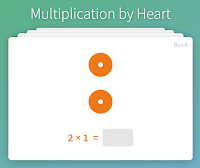
The Multiplication by Heart cards (created by Math for Love) are great visual practice for students as they learn to understand and master their multiplication facts.  


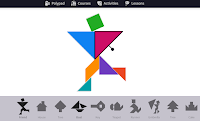
Of course, I also enjoy the Tangram  Builder which is located in the Activities section.


Exploding Dots can also be found here.  If you have not spent time in the Exploding Dots world by James Tanton, do yourself and your students a favor!  It would make for a great exploration for your students.  The Exploding Dots experience on Mathigon is an extension of the actual website, but still one to get you thinking.


What really got my attention on Mathigon is its Polypad section!  It has so many unique manipulatives and tools to offer your students.

This polypad includes a balance scale and fraction bars. Each could be used separately.


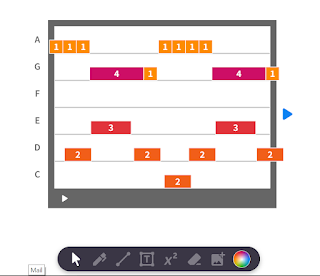
Students can make music using these tools found in Polypad.


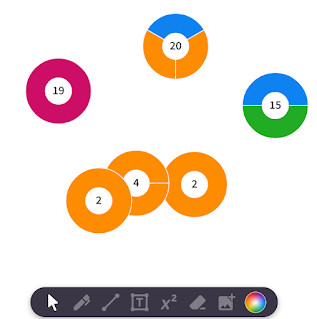
These Prime Factor Circles are a match to Prime Climb and can be decomposed (if composite) or combined as you wish to create new products.


This is just the tip of the iceberg in this fabulous site.  You can save and link activities that you make within the Polypad, but you can also use some of the many that are already prepared.  One last thing to explore is the Lessons tab.  Inside of there you will find your way to a variety of puzzles and explorations for you and your students.

Take the time for your students and yourself to explore this site.  You won't be disappointed!


Monday, May 10, 2021

Best Practices: Where can you grow?

 It has been a crazy, stressful year.  The good news is that the end is in sight for this school year.  And, while we may still live with some restrictions when our new year arrives next fall, we anticipate that many things will return to a more typical format for instruction.

So--let's look with next year in sight.  I know your summer is looking promising.  You can't wait to just relax and enjoy all that the world has to offer without the weight of instruction on your mind.  However--I imagine, like me, you find it difficult to totally turn off school.  Here are some things you might consider looking into to grow as a math teacher for next year.  Think about these best practices.  Which ones seem reasonable for you as you continue on your math journey?  You might choose two; you might choose seven.  Do what works for you.


Daily Routines:  Using the beginning moments of your workshop to get everyone thinking around an interesting problem is a great way to get the juices flowing!  I would definitely include traditional number talks in these routines, but there are so many others to consider.  Look for low floor/high ceiling routines that allow all students to enter into the problem and encourage creativity and fun for all.


More Manipulatives:  CRA Instruction "puts math in students' hands so they can understand it with their heads."  All students benefit from this type of instruction, but sadly, we tend to move away from it too quickly. It is one of the best ways for students to gain conceptual understanding of concepts.

Numberless Word Problems:  Key words are cancelled.  They are not a good instructional practice because they do not encourage good thinking from our students.  Taking some time to think around word problems that do not have numbers is a fabulous strategy for our students.  It not only shows the link between reading skills and math context, but it puts another tool in our students' toolboxes that they can use when they are confused by a word problem.  Remove the numbers!

Counting Collections:  The counting collections activity is way more complex than just counting, but it is also as simple as just counting.  The CGI approach is really working hard in this activity that I love to use from K to 5th!  (It could be used with older students, too!) It is an in-action practice of concrete, representational, and abstract.  This can be done by individuals or in pairs, but as always, the sharing at the end is where the real learning occurs!  You do not need anything fancy to count, so don't feel like this is something you have to go out and buy materials for.


More Visuals:  Math is visual.  Find ways to help students SEE the math in everything you do.  From representations during Number Talks to counting aloud visuals to the Same/Different routine to Prime Climb or Tiny Polka Dot, put the math out there in a way that students can engage with and understand.  Visuals help all students to engage and step-in to the lesson.


Three Act Tasks:  These offer such a good opportunity for our students to  make sense of math, and they do not follow the "I do, we do, you do" instructional format.  There are so many available to choose from.  The tab at the top of this blog is a rabbit hole that will take you to quite a few.  How can you be more intentional about using them next year?

Heterogeneous Grouping:  Tracking students is not an equitable practice.  All students need the opportunity to see and do high level tasks.  Let's not limit our students.  Be more intentional about grouping your students with students of varying strengths.  Don't underestimate what your students can do.

More Incorporation of Data:  Jo Boaler has added resources to her Youcubed website around data.  SlowRevealgraphs.com  has a number of prepared slide decks for many different levels.  These can be used in math class or incorporated into content areas.  Teaching our students how to read, question, interpret, and create various data representations is an important 21st century skill.

Desmos:  This platform offers so much for students, but also for teachers!  The platform is manageable and you can find a large number of ready-made activities that go beyond DOK 1 on this site.  I have many listed and aligned by standard in the Resources to support CCSS tab at the top of the page.

Weeks of Inspirational Math:  I have blogged about this more than a few times.  1st time   2nd time  3rd time  I love these!  I believe strongly you will, too, and so will your students.

Puzzles:  Our students do not have enough experience with persevering through challenging problems, and puzzles (both paper and tangible) give them experience with this skill.  Maybe you just add a jigsaw puzzle table next year, or maybe you take on KenKens--either way, your students will grow! (and probably have a little fun along the way)


Each year, we step into our classrooms with a fresh start and with plans of doing better than the year before.  By challenging yourself to grow in your math instruction, you will not only grow, but so will your students!  Good luck.


Saturday, October 17, 2020

So much good in one place!


Many of you are familiar with the beauty of Splat! and all that it can offer our students.  It also has the great quality of being a routine that can be used throughout school.  It is certainly a routine that students, teachers, and this math specialist love due to its visual qualities, critical thinking elements, and engaging ways!

But the master behind Splat! has many other great resources available to teachers.  They are opportunities to expose our students to many concepts and to encourage some rich discourse in our classrooms.  And, best of all, Steve Wyborney shares his wonderful creations with us in the form of free downloads.

These resources are good in a normal year, but this year, they are especially nice to use in a virtual learning format.

Here is a run-down of some of the things you can find from Mr. Wyborney:

Splat!:  Beginning with concept of missing addends, the Splat slides move from primary concepts to fractions and algebra as the slides become more complex.  Students benefit from the visual nature of the slides, and they love the game feel of it all.

Esti-Mysteries:  Another popular routine with students, esti-mysteries merge the skill of estimation with critical thinking.  One clue is revealed at a time so that students can narrow down their choices.  In the end, they still depend upon their estimating skills for a final decision.  One thing I like about this routine is that once it has been taught, I think it can be used in many ways including revealing a clue a day with the final discussion occurring at the end of the week.

Estimation Clipboard: This is one of my favorites!  This routine again builds off of the concept of estimating and makes it fun for students to take the risks when making an estimate.  An image is shown, students make an estimate, and then the answer is revealed. Another slide is shown with a change in the image, and the students adjust their estimate.  This simple routine has hidden sophistication in that it often has hidden benchmarks for students to use to be able to make a better estimate.  Many of the images are about number, but I especially recommend the slides that deal with length.

Cube Conversations:  These 3D images are a great way for students to get an introduction to volume and to build their visual and grouping skills.

Tiled Area Questions:  Beginning as general area problems, these develop into more complex relationships between whole and fractional numbers.  Again--an opportunity to stretch our students' thinking and their abilities to justify their thinking.

His animated multiplication chart is a nice tool for students to explore patterns and be exposed to their facts.

I know that for many of you Splat! is a common routine used in your classroom, but I wanted you to be aware of some of the many other treasures that you can find on this website.  If the past proves anything, I would bet we can look forward to other great ideas to be created by him in the future!  Have fun exploring this awesome sight, but more importantly, have fun watching your students think, engage, and discuss mathematics in such fun ways!

Friday, July 3, 2020

Individual student toolkits for CRA instruction


If students are in your classroom in August, it will be worth your time to have some sort of math tool kits prepared for your students because it is not recommended that students share resources, and you don't want to be cleaning them every night. What you are able to put in the kits will depend on your resources.  

We know that CRA instruction is vital for conceptual understanding of mathematical concepts.  Just because we will have some limits in place (for everyone's safety), doesn't mean we should abandon best practices.  We just need to adjust and do what we can for our students.

As I have said before, the use of virtual manipulatives will probably increase in your instruction even if you are seeing students in person.  This is especially true for those manipulatives where students usually need a lot of them to do their work--like pattern blocks and base ten blocks. I recommend that you use the virtual versions some in the classroom so that students are comfortable with the websites if they should need to use them from home without your direct support.

You might also consider paper versions of some of these tools to have in students's toolkits.  Not only can you get them easily and cheaply for the classroom, but you can also send them home if you need to without the worry of losing valuable manipulatives.

You may not start the year with all of the items in the toolkits.  You might add some as students are introduced to new concepts. Here are some things you might consider putting into individual toolkits for your students:

K:
hundred grid from nrich.maths.org
number path  1-20 by Berkeley Everett
ten counters (unifix cubes?)
rekenrek
real or paper pattern blocks by Mathwire
+/- Math Flips cards (+/- 1) by Berkeley Everett
Quantity Cards from Erickson Early Math Collaborative
pair of dice

1:
hundred grid from nrich.maths.org
number path  1-20 by Berkeley Everett
twenty counters (unifix cubes ?)
rekenrek
beaded number line
small clock face paper version
real or paper pattern blocks by Mathwire
pair of dice

2:
hundred grid from nrich.maths.org
number line 1-20 by Math Salamanders
twenty counters (cm cubes?)
rekenrek
beaded number line
small clock face   paper version
play coins, dollar bills
ruler
real or paper pattern blocks by Mathwire
real or paper base ten blocks from Tim Van de Vall
+/- Math Flips cards by Berkeley Everett (Doubles/Near Doubles) (make 10 with 2 addends)                        (make 10 with 3 addends) (2 digit + 1 digit) (2 digit + 2 digit) (subtraction within 20) (subtraction within 100)                                                                       
pair of dice

3:
twenty or more counters (cm cubes?)
beaded number line
small clock face   paper version
play coins, dollar bills
ruler
10 x 10 array (laminate)
real or paper pattern blocks by Mathwire
real or paper base ten blocks from Tim Van de Vall
paper Fraction Strip  from Math Salamander (blank version)
paper Fraction Circle Pieces Page 1   Page 2  Page 3
+/- Math Flips cards by Berkeley Everett (if needed from previous grades)
 x Math Flips cards by Berkeley Everett (2s,5s, and 10s) (4s, 6s,& 8s) (3s & 6s) (9s & 4s)
pair of dice

4:
thirty-six counters (cm cubes?)
beaded number line
ruler
10 x 10 array (laminate)
real or paper pattern blocks by Mathwire
real or paper base ten blocks from Tim Van de Vall
paper Fraction Strip  from Math Salamander
paper Fraction Circle Pieces Page 1   Page 2  Page 3
+/- Math Flips cards by Berkeley Everett (if needed from previous grades)
 x Math Flips cards by Berkeley Everett
pair of dice

5:
thirty-six counters (cm cubes?)
beaded number line
ruler
real or paper pattern blocks by Mathwire
real or paper base ten blocks from Tim Van de Vall
paper Fraction strip from Math Salamander
paper Fraction Circle Pieces Page 1   Page 2  Page 3
Math Flips cards by Berkeley Everett (if needed from previous grades)
pair of dice

If you laminate many of the paper tools, students could use a dry erase marker to create representations.

What am I forgetting?


Sunday, May 17, 2020

Looking for Virtual Manipulatives?

While we are still unsure how our instruction will be delivered in the fall, there is one thing we are sure of....student's involvement in the concrete phase of learning math is important!

Sending home concrete manipulatives for all of our students may be too costly for most schools.  Purchasing enough to send home is not the only problem: we know it is doubtful that many of these tools will return to our buildings.  With that in mind, here I am going to highlight some of the best virtual manipulatives I have been able to find and use.

I highly recommend using these with students this fall even if we are face to face.  Allowing for guided use now will make it easier should they need to use them again at some point in the year.

I have always been a fan of Math Learning Center Apps, and I have shared these apps with many teachers before! These apps have always been free and easy to access and use.  Because of the pandemic's rise in at-home schooling, they have added an extra feature!  Sharing!  Four of the apps can be set and shared with students and/or students can share with you.  There is a video explaining how this works, and I have had success with it myself.  There are many great apps here.  Some of my favorites include the Number Rack, the Number Line, and the Partial Product Finder.  However, I can think of many great uses of the other apps.  I just have not used them myself in a classroom.
These are the apps that allow sharing at this time.
Toy Theater also has a great selection of virtual manipulatives. I do not have as much experience with these, but it has some great ones such as interactive hundreds and mulitiplication charts, a variety of counters, dice, and some graphing apps.  I think it could meet a lot of needs!
A great variety
Didax also has free online manipulatives. I have only found these while I've been sheltering at home, so I do not have experience in the classroom with them.  You'll find many that are available above, but here you will also find linking cubes and a math balance!  It also has algebra tiles and prime factor tiles that can be used in middle grades. (because manipulatives are just as important there!)

A few other places that you can find specialty links:
MathToybox has a Cuisenaire rods app.

ABCYa has some fraction tiles that are nice.
I hope you can take some time to explore these apps and find the ones that will work best for you and your students' needs!  It might be a good way to start the school year, whether we are virtual or in-person, to spend some time walking students through these tools, how to get to them, and how to use them.  That way, when the time arises, they will be able to use them more independently!  Remind them that they can use them and explore with them whenever they want.  Exploring these tools independently helps students to see relationships and make sense of it all on their own.

The other thing that is great about these virtual tools is that you can use them to create your visuals for your SMART docs, Google slides, or student tasks.  Math is visual, and these provide us with good ways to show the math to our students.

I hope we have the chance to use concrete manipulatives in August with our students, but now is the time to prepare in case we don't.  I hope you can find tools at some of these sites that match the ones your students typically use in the classroom.


Monday, December 30, 2019

An exploration for 4th grade

A site that I often frequent for good math inquiry problems is http://www.inquirymaths.org/.


This is a good inquiry I found there for 4th (and 5th) graders.

 24 x 21 = 42 x 12

The link gives good directions and discusses the importance of student conjectures and exploration.  But it leads me to another idea:  How much more valuable is solving this problem and thinking about it deeply than doing a page full of double-digit multiplication?   We sometimes practice the way we were taught, but many times, there are way better ways.  Students, in this case, solve two multiplication problems, look for patterns, develop conjectures, and then work to test those conjectures.  More math problems are being practiced while students are doing some important noticing and thinking.  So much better than a sheet full of double-digit problems.  

Friday, December 6, 2019

Sorts

Sorts are a great way for students to make sense of things around them.  It could be images or numbers or objects or words....the point is to get them thinking about a subject and have them make sense of it in some way.

Here are some ideas for sorts.  Don't think that these are just for Littles.  Older students enjoy them.  They offer a non-threatening way for students to look at things, and they offer us good insight into our students' thinking.  Sorting is very mathematical even when it is not about numbers.  It is about looking at things carefully, finding patterns, and making sense--that's math!

SORT:
pattern blocks
doors
coins
book characters
drain covers
shapes--2D and 3D
numbers (odd/even) (prime/composite) (square/not square) (multiples)
vehicles
words
patterns
emojis
food
volume/area/perimeter
shoes
states
types of graphs (no numbers or titles are necessary)
expressions
angles


Friday, October 18, 2019

Playing with Numbers

After reading the book Math Recess by Sunil Singh and Dr. Christopher Brownell, I realized the importance of giving students time to explore numbers by playing with them.  This post shares a couple of ideas for these explorations.


This book is a great read and will make you rethink your instructional practices!
Abundant Numbers:  Have students search for ABUNDANT NUMBERS.  A number is considered abundant if the sum of its divisors is greater than the number.  For example, twelve is abundant because its divisors (1,2,3,4, and 6) is greater than 12.How many can your students find?

Circular Primes:  A circular prime is one that remains prime with the relocation of the first digit to the end.    So for example, 113 is a circular prime:  113 is prime.  When I move the 1 to the end of the number, my new number is 131, which is also prime.  When I again  move the first digit to the end, I get the number 311.  It is also prime; so it means that all 3 of those numbers are CIRCULAR PRIMES.

Happy Numbers: 19 is a HAPPY NUMBER.  How do I know?  To find a happy number, square each digit and find the sum. Continue doing until you find the final number.  If it is 1, then the number is happy.  
Click here to see how I know 19 is happy!

Make it a goal to give your students some time with these ideas.  Can they find more of any type of number?  How many can your class find this week?  before winter break?  this school year?  Can they prove that the numbers they found fit the definition provided?


Let your students spend time playing and thinking about numbers.  

Tuesday, October 1, 2019

Put Math in their Hands

I often talk to teachers about the importance of concrete representations for our students.  The use of concrete tools helps all students to gain a better understanding of the function at hand.  It also creates a visual representation that will be a reference for students to use as they advance into more advanced mathematical ideas.

In this post, I want to share some simple concrete representations that teachers can help students develop as they work to make sense of a new concept.

Doubles/Doubles +1: Both the rekenrek and ten frames help students to make more sense of what a double is and how we build from that to doubles + 1.


Doubles on ten-frame:  3 + 3 =6


Doubles + 1:  3 + 4 = (3 + 3) +1 =7


Doubles on rekenrek: 6 + 6 = 12


Doubles +1:  6 + 7 = (6 + 6) + 1 = 13

The rekenrek is a great tool for doubles facts between 10 and 20.  Student can see that all of the green beads have been pulled over, which is 10.  They only need to add on the white beads.


Addition/Subtraction within 100:  For this skill to take hold, I find beaded number lines and base ten blocks to be good concrete tools to use because they carry over so nicely into an open number line representation.  Open number lines are important for students to use to build number sense.


Addition on Beaded Number Line:  17 + 35 = 52


Addition with Base Ten:  17 + 35 = 52


Subtraction on Beaded Number Line:  44 - 18 = 26
Open number lines are important, but they are often too abstract for many of our students.  Combining the use of the beaded number line or base ten blocks with the creation of an open number line helps for it all to make more sense for the students.

Multiplication:  For learning multiplication facts, creating arrays is a nice way to start.  This should help students to see how repeated addition is connected to multiplication.  Any small object will work to help students create arrays.  Using the number card templates will allow them to create a visual more quickly at times when they need a visual but don't have time to build an array.


Multiplication with Base Ten Blocks:  22 x 23 = 506

The 22 and 23 were created at the top of this image and on the left side of the problem using base ten blocks.  Multiplying a blue ten and anothe blue ten gives you an orange 100.  The same continues until we end up with 4 hundreds, 10 tens, and 6 ones for a total of 506.

For multi-digit multiplication, building the array using base-ten blocks works well to connect the arrays that student made for facts under 100 with the longer problems that they are ready for now.  Besides--the base-ten blocks transition nicely into graph paper representations and finally into the area model of multiplication for multi-digit numbers.

Decimals:  The beaded number line can be used for addition and subtraction of decimals less than 1, and it can also be used to round and compare decimals.


Rounding on the beaded number line:  0.86 is closer to 0.9 than 0.8


Adding decimals on a beaded numer line:  0.6 + o.14 = 0.74


I hope that you find some of these ideas helpful and that you find ways to incorporate them into your explanation of numbers with your students.  There are many ways that can be used for different problems.  If you have a concrete tool that works well for teaching these skills, don't think you have to switch to one of these--do what works best for you and your students.  The key is to get the concrete math in their hands!  This way it will stick in their heads.  😊

Monday, November 26, 2018

3 Act Tasks: Have you tried them yet?


3 Act Tasks offer our students such an engaging opportunity to make sense of math! However, as teachers, sometimes we are afraid to try something new not knowing where it might take us and scared that something bad might happen.  I just heard an analogy recently about this being like being at the top of a rollercoaster:


via ytCropper
And, while it might have twists and turns and dropoffs, not to mention bugs in the face, it also brings an excitement and thrill that we rarely find doing a traditional math lesson. We need to think about putting ourselves in that precarious position at the top of the rollercoaster; it's what we ask our students to do on a regular basis so that they can grow.  We should try it, too!

3 Act Tasks are real-world problem-solving scenarios which require students to make sense of what to do.  During Act 1, they use the reading skills of visualizing, predicting, and inferring in a math context.  They figure out what they need to know to solve the problem. In Act 2, students work to solve the math question in a way that makes sense to them. They discuss their thinking with a friend and compare their answer to their estimate.  Act 3 is exciting because that is when they find out if they were on the right track!  


While they are working during Act 2, you are monitoring (and asking questions that help them understand--not helping too much).  You are monitoring to see the methods that students used in order to solve the problem.  During Act 3, it is your job to have students share ways that they solved the problem.  These should be sequenced so that you can show connections between different methods. Be clear on what your math target for the lesson was and be sure that your models and discussion help that math target to be evident to everyone.  You synthesize the learning at the end of the lesson.


3 Acts are very visual and often use videos to help students better understand the situation. They follow more of the format of "you do, we do, I do" rather than the traditional layout of "I do, we do, you do."


Typically, a 3 Act Task in K-2  about 20-30 minutes.  In 3-5, a task usually takes about 4o minutes.  As students get stronger and more comfortable, the time needed for a 3 Act might decrease.


I am happy to come and model a 3 Act Task for you and your class, but I know that many of you can do them without my support.  You just need to put yourself on the rollercoaster!


At the top of this blog, you will find a tab labeled 3 Act Tasks.  This will take you to a large number of standards-aligned tasks that I have organized using SMART Notebook (and sometimes Google slides).  They are by a variety of mathematicians; I just put all of the pieces together into one format.  You can also find more great tasks by clicking here or here or even by Googling 3 Act Tasks.


As always, share with me your questions, struggles, or successes and let me know how I can help!

Thursday, November 15, 2018

A Stepping Stone to a More Student-Driven Workshop

If you are still looking for ways to make your math workshop more about collaboration and problem-solving rather than about independent work and computation, a Week of Inspirational Math by Jo Boaler/Youcubed might just be the ticket!  If you have done any of these lessons before, you know how awesome they can be!  Well--she has recently posted her WIM #4!  That's right--4 weeks of math explorations and engaging lessons that you can use to build your mathematicians.

These engaging lessons are organized by grade level strands and are grouped into a week's worth of lessons.  They are great to use a week at a time, but you certainly could use them independently if you needed to.  They embody the paradigm shift in math education with a focus on growth mindset, visual math, patterns, and collaboration.

Besides that, each lesson will really engage your students for at least math period.  (Oftentimes, students keep working on the problem after class...) Each lesson begins with a video that you can show if you wish.  It helps to build the growth mindset in your students and presents them with mathematical thinking that helps them to see math is all around them.  After the video, there is a lesson (with full lesson-plan) that you can have students work on in small groups and share out with the class.  You can learn so much about your students as you circulate the room listening to their thinking, and they will learn so much about themselves as mathematicians!

With the craziness of the holidays, you might find a few days where some WIM activities are just the ticket, and they might cause you to begin rethinking your workshop!  They might be a good way to spend your math time during those days right before holiday break, but they might also be an awesome way to set the tone for 2019!

I have blogged about WIM before, but I can't tell you enough how much they can invigorate and change your classroom, your student's thinking, and your own thinking!  Time well spent!

Tuesday, October 23, 2018

Building Conceptual Understanding of Fractions

In 3rd, 4th, and 5th grades, fractions dominate much of our instructional time, and it is important that we work to help our students gain a firm grasp on the concepts of fractions. Going deep now will help them down the road as they use fractions in more complicated mathematical situations.

A reminder of the progression of fractions in elementary school by Graham Fletcher allows us to remember how important our models are:


Sometimes I'm afraid that teachers steer clear of fraction exploration because they are uncomfortable with them themselves.  Imagine all of the learning that could occur if we went out of our own comfort zone with our students?  

I have shared Fraction resources before in this blog.  I have also shared an exploration or two.  Here are some more resources that might help your students (and you) to make more sense of fractions.

When and when not to give the answer:  This Marilyn Burns' post offers an opportunity for your students to build their own understanding of fractions.

Fractions, Decimals, & Percentages:  A number talk which begins with fraction addition.

Exploring Fractions:  An article from nrich.maths.org which offers links to rich tasks that develop a deep understanding of fractions.

Illustrative Mathematics also has some resources that will help you better understand the horizontal progression of fraction skills.

Maybe you find one or two ideas above to help you stretch during your fractions unit--that's great!  Don't try to change everything all at once. As always, let me know if there is something I can do to help!

Friday, August 31, 2018

Continuing to Find Ways to Build Math Talk


I have participated in a number of professional discussions in the last week around the concept of Number Talks.  You may remember that I blogged about Sherry Parish's book before. It is an excellent resource to help you get started with Number Talks.

Many classrooms use Number Talks every day.  It is a great tool for building mathematical discourse, exposure to new strategies, and strengthening students' flexibility and fluency.

However--some people are a little intimidated by Number Talks.  It has some elements of the unknown, and this makes teachers a little leary to try it with their own students.  This is totally understandable.  One way to make this work is for the teacher to work on the anticipation part of the number talk fully.  By anticipating all of the possible ways a student may respond, it will give you the preparation to feel confident as you step into the Number Talk.  It will also allow you time to prepare visual images to represent ways that the students might explain.  It is important that we show the students' ideas using visual representations as this will allow us to reach more students.


Here is a great example of ways that students might see 18 x 5.


I do believe that the term Number Talk is broader than just the use of functions with numbers as is found in the Number Talks book.  Of course, traditional number talks often involve quick-look cards and other visuals to help students visualize the math, but they are still considered to be from the basic concepts presented by Sherry Parrish in her book.

If you click on the tab labeled Routines located at the top of this page, you will find links to resources and videos of a large variety of mathematical routines that will encourage students' math talk.  There are many low-floor/high-ceiling activities which are good to put the students (and sometimes the teacher) at ease when doing a number talk.  In these types of tasks, nearly everyone can find an answer right away, but because these routines lend themselves to multiple answers, we find students recognizing all kinds of things besides the obvious.  Using these type of routines in addition to Number Talks will help your students to grow in ways you won't believe!

Challenge yourself to something new.  Try to add routines to your math class each day--you will be glad you did!

Monday, August 13, 2018

Virtual Concrete Manipulatives

We know how important concrete manipulatives are for our students as they build a deeper understanding of mathematical concepts. Being able to see and manipulate objects enables students to visually represent problems, see patterns, and make connections.

Hopefully, you have a variety of manipulatives in your room that students can easily access at all times.  Virtual manipulatives are important to have easily accessible, too!  Now is a good time to download some of these apps onto your iPad, bookmark on your computer, links in your SMART Notebooks or PowerPoints and/or add to your Symbaloo!


There are a lot of great FREE virtual manipulatives out there, but today I want to focus on the apps by Math Learning Center.  I have good success with many of them. The site has a lot of other good resources, so when you have some time, check them out as well!


Fractions: This app not only allows you to create bar or circle models of fractions, but it also to layer fraction models to see if they how they compare to one when you add them.
3/5 + 1/3 < 1
The app allows you to place number models or write directly on the screen as well. Take some time to explore the capabilities of this app!


Vocabulary Cards: Another great app that you can probably find multiple uses for! There is a large database of words in this app divided into grade bands K-2 and 3-5.  You can choose to see them all or only certain words.  Each card has 3 parts: the word, examples, and a definition.  You can choose which part you want hidden.  You can also choose the language for the card. I can see these being used as individual review for students, but I can also envision one of these on the board as an intro activity or even a quick exit task.

Money pieces:   The money pieces app allows you to display money with or without the accompanying base ten blocks depending on student needs.  It also has a variety of tools similar to the games Bears in the Cave or Pennies in the Hand where you can put your coins up and then hide some.  For example.  I have a pocket in the above screen.  If I told you that I have 35 cents altogether, can you tell what I have in my pocket?


With the click of a button, I can remove the pocket to show that there is a quarter in it.  You can do this similarly with a hand or a bank.  

Money seems to be difficult for children anymore because they have less interaction with it than we did. Our students don't get the same opportunities we did to spend cash, but it is still important to understand, and this app will give them some basic experiences with it.


Number Frames:  This app not only allows the important 5 frame, 10 frame, and Double 10 frame, it allows you to customize the frame you want up to 120. As with many of the apps, it allows you to enter number sentences and to write on the screen.  This app is not just for Littles!  Teachers in 3-5 can use it to explore place value as well as patterns in multiplication.


Number Lines:  I love this app!  It has so many options for you to customize the number line including fractions, decimals, hidden numbers, hidden tick marks... I think it really helps students to represent their work, and it marries nicely with the beaded number line for moving from concrete to representational.


Number Pieces:  There are two versions of this app.  The one I am showing above is more advanced than the version called Number Pieces Basic. It is base-ten blocks, but you can break the large pieces apart to show number relationships. You have choices in color and orientation of the pieces.  Again, you can enter number sentences or write on the screen.


Number Rack:  You know how much I love this one!  It comes in handy as a teacher model on the SMARTBoard as students manipulate their own Rekenreks.  It is customizable by sets of 10 up to 100. It allows for teacher annotations like the others, but it also allows for teachers to hide beads as below.  Well worth your time to explore this one--not just for Littles!

Do you know how many beads I have hidden?


Pattern Shapes: It is so important that we give students time to play with pattern blocks!  This offers a blank mat for students to create their own patterns.  It also has templates (as above) for students to fill in with shapes.  (Very good for sharpening visual skills)  For older students, it has two different grid backgrounds to allow exploration of area and perimeter.


Geoboard:  The geoboard app has different sizes of geoboards and allows for customization in many ways.  Another great one to have up on the SMARTBoard as students manipulate their own geoboards.


Partial Product Finder: While still in Beta form, this is an awesome app to help your students better understand partial products as well as the distributive property.  You can customize the rectangle up to 30 x 30 and then decompose one or both sides.  The matching equation shows up at the bottom of the screen. I have blogged about this one before--it is awesome!

I highly recommend that you take some time to explore these!  Hopefully you will find some that you make available for student use just as you do other manipulatives.  Maybe you'll find ways to use them within your instruction.  Whatever works best for you and your students!  


Let me know if you have other virtual manipulative apps that you would recommend!