Monday, October 9, 2017

A Parent Resource

I found this website recently, and have found some great resources on it.  It is intended to help parents talk math with their children, but I think it can give us some good ideas to tie math to the real world in our classrooms.

The site is called Table Talk Math.  This link will take you to the homepage, but the main place of inspiration for me is the Newsletters link.  In this link, Mr. Stevens shares everyday math examples and how we should talk to children about them.

Please consider sharing this link with your parents.  We need to continue to encourage parents that math is not about a set of problems on a worksheet or memorizing your facts.  It is real-world, and it is all around us all of the time.  I think this site will help them start to see that themselves!


I think the book by John Stevens looks like a good resource, too, so maybe I'll add it to my Christmas list.  It is only 11 weeks away, ya know? :)

Tuesday, October 3, 2017

One More,One Less

In a recent meeting with our building interventionists, they shared their concerns about students in upper grades who cannot count backwards--especially when they have to cross a ten (42, 41, 40, ?).  I have found a similar problem in a number of the Firsties that I work with.  These students can rote count, but they aren't always sure of the meaning of "before," "after," "one more," or "one less."

This lack of number sense is concerning, but I think we can find ways to strengthen our students' understanding through continued practice and modeling.  I have created this SMART Notebook resource as a way to help us meet this problem head on.  If this is a problem you know that some of your students face, you might be able to use this document in small group, or as a class warm-up every now and then.

Counting backward and understanding the relationship between consecutive numbers would fall into one of our Essential Skills.  Please share in the comments below if you have other ways to help build this understanding in our students.

Wednesday, September 13, 2017

Everyday Math In/Out Tables

In/Out tables are a big part of Everyday Math.  For years, I have used the Function Man SMART Notebook pages to help kids better engage with the concept. I could easily change the pages to make the function be what I wanted.

Well--how about this?


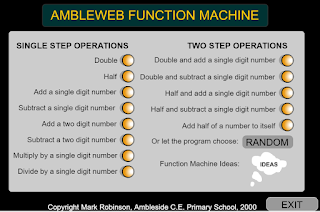
This function machine by Mark Robinson has a menu of choices for you to choose from.  


The sound effects will make it engaging and interesting for students, too.  Just stick a link to the machine in your math workshop SMART doc.  Then you will have access to it whenever you wish!

What a fun tool.  Be sure to share with your team.

Sunday, September 10, 2017

Websites to help you kick your teaching up a notch!


I have recently come upon these math websites...

I think they can be used in a variety of ways in our classrooms. There are prepared resources on these sites, but they might also inspire you to create your own.  It might also be a good opportunity for students to create them.

Would You Rather?  This site gives two mathematical questions and students have to determine which they believe will give them the better result.

Estimation 180  This site offers opportunities for students to estimate with the hope that practicing estimation more often will build their number sense.

Fraction Talks Images from this site support the teaching of fractions.  Ideas for using these images are limitless, but as a number talk might be a great way to start.

Visual Patterns  The images on this site are the beginning of a pattern.  Can your students figure out how the pattern works?  Can they write an equation to match it?


All of these sites offer opportunities to expand their thinking and especially their thinking about math.  Many of them are low floor/high ceiling tasks meaning that all of your students can be successful with them.  Consider using them with all students!

I would be happy to help you find ways that these activities could work for you and your students.  Just let me know how I can help!


Thursday, August 24, 2017

Unit 1 Extension Opportunities


Here are some resources that you might decide to use to extend your students' learning during this unit. I looked for activities for each grade level that would extend our students' understanding of concepts presented in the unit.  They are listed below.

1st grade:
LOGIC:  https://nrich.maths.org/7227
LOGIC: http://www.enchantedlearning.com/math/logic/puzzles/pets.shtml
ADDITION: http://www.openmiddle.com/equality-2-2/
COMPARING NUMBERS/ADDITION GAME:  https://www.gregtangmath.com/howmany
ADDITION: The Very Hungry Caterpillar
GAME:  123 Nim  
LESSON:  Domino Sorting

2nd grade:
PROBLEM SOLVING: https://nrich.maths.org/1005
MATH ARGUMENTATION:  https://nrich.maths.org/7383
GRAPHING: http://www.openmiddle.com/interpreting-data-2/
COINS GAME: https://www.gregtangmath.com/coinbubble 
LESSON:  2,4,6 Puzzle
PUZZLE:  Flower Petal Puzzles

3rd grade:
TIME: https://illuminations.nctm.org/Lesson.aspx?id=2328
ELAPSED TIME: https://illuminations.nctm.org/Lesson.aspx?id=3966
MULTIPLICATION: https://nrich.maths.org/1252
TIME: https://nrich.maths.org/1002/note
TIME: http://www.openmiddle.com/operations-with-time-2/


4th grade:
PLACE VALUE: https://nrich.maths.org/5950/note
PLACE VALUE: https://nrich.maths.org/2006/note
PLACE VALUE: http://wild.maths.org/tags/number-bases
SUBTRACTION: http://www.openmiddle.com/subtracting-multi-digit-numbers/
PERIMETER: http://www.openmiddle.com/rectangles-maximizing-perimeter/
PERIMETER/AREA: http://www.openmiddle.com/squares-perimeter-v-area/
GRAPHS: https://illuminations.nctm.org/Lesson.aspx?id=754

5th grade:

Thursday, August 17, 2017

Try A Week of Inspirational Math!

Looking for ways to promote growth mindset in math in your classroom? I highly recommend trying some or all of the activities from Jo Boaler's weeks of Inspirational Math!

This was started 3 years ago, and she has three weeks' worth of lessons/resources available on her youcubed site.  You can access them HERE.

The activities are identified by grade level and organized a week at a time.  (K-2 only has two weeks worth of activities although you may be able to modify some of the 3-5 activities from the first year.)

You might decide to start your class with these activities each day for a week as you develop your workshop expectations and social norms.  Maybe it will work better to just dedicate one day a week to the activities.  You decide what will work best for you and your students!

Let me know if you have questions or could use any support!


Monday, August 7, 2017

K-1 Essential Skills


Excited for the new year?   I know you are!  And...I know you have spent your summer putting together ideas on how to make your classroom and instruction even better. 😊

I just wanted to remind you about our discussion on Essential Math Skills by Bob Sornson last spring.  Have you thought of ways to measure these to start the year so that you can identify who may need some additional support or instruction?

In Kindergarten, you would only need to measure the first 4, because the next 4 aren't expected to be mastered until the END of kindergarten. 

We hope these are the skills that arrive with our kiddos when they come to kindergarten:

1. Demonstrates 1 to 1 correspondence for numbers  1-10 with steps
2. Demonstrates 1 to 1 correspondence for numbers 1-10 with manipulatives
3. Adds on/takes away using numbers 1-10 with steps
4. Adds on/takes away using numbers 1-10 with manipulatives

You probably have a pretty good idea right now whether the majority of your students will or will not have these skills.  This will mean you are really looking for the outliers.  The book that was given to each building has a checklist in it that you can use to keep track, or maybe you have a way that will work better for you. 

You might find it easier to do whole class activities to look for these skills, or you might decide to use stations so that you can watch your students in smaller groups.  Whichever you choose, I recommend trying to embed the activities into your beginning of the year activities and math workshop development so that it is not more days of formal assessment for you and your kiddos.

Once you identify the kiddos who need more support, hopefully, you can build time into your Unit 1 and 2 lessons so that you can work on strengthening these skills for them.

This is the early numeracy progression video by Graham Fletcher that we shared in the spring.


In First Grade, you may want to measure the first 8 skills, as the remaining 5 are not expected to be mastered until the end of 1st grade.

So, in addition to the 4 skills above, 1st grade teachers may want to watch for these skills at the beginning of the year:

5. Demonstrates counting to 100
6. Has one to one correspondence for numbers 1-30
7. Understands combinations to 10
8. Recognizes number groups without counting 2-10

I think that many of these skills go naturally together as a progression, so for example, a 1st grade activity might begin with one to one correspondence within 10 and build to 30 with possible addition and subtraction within.

We want you to watch for these skills in a way that works best for you and your students. This is going to look different for each of you, and that is fine.  

We do ask that you continue to move through your grade level's units and assessments.  All students should be exposed to your grade level's CCSS, and many will be able to master those.  However, some students will need more time to develop these essential skills, and that is okay. We hope to get to a point where nearly all students can leave with these essential skills so that they have a strong foundation to build on in later grades.

By the end of 1st grade, we hope that our students possess the 8 skills above as well as these remaining skills:

9. Counts objects with accuracy to 100
10. Replicates visual or movement patterns
11. Understands concepts of adding on and taking away (within 30) with manipulatives
12. Adds or subtracts single-digit numbers on paper
13. Shows a group of objects by number (to 100)

Recommended activities and ideas are included in the book that we gave to each building last spring. Here is the link to the folder we created in the spring that might help you with ideas and activities for your classroom.  In addition, here is Mr. Sornson's website.


This is the addition and subtraction progression video by Graham Fletcher.


Let me know what questions you still have or how I can support you.